Thursday, September 29, 2011

Daytrip - Algonquin Edge Scouting Trip

Here are some shots of a daytrip to the Western Edge of Algonquin Park. Fall colours have begun. Some of my previous experiences in Algonquin park have been disappointments...mostly because of dirty campsites littered with refuse from disrespectful campers. These tend to be the well used "maintained" routes.

With a single day devoted to exploring, I thought I would venture to a region that is technically not part of the park, and therefore appears on maps as an "unmaintained" region. An added bonus is that it is only 20 minutes away from our Cottage.

Access is from a little trail right off Highway 60 which leads into a boggy section of "Park Lake". On the Algonquin Adventures forums a while back, a question was asked about the worst/ugliest lake in the whole park...someone answered this "Park Lake". Wasn't that bad in my opinion...but its unfortunate location running parallel to the busy Highway 60 corridor means you certainly hear transport trucks rumbling over the hilly terrain. Not much of wilderness experience here.


Start Access Point


View across the length of Park Lake


Hills stating to change

Despite this, the lake had lots of wildlife, owing to some boggy areas along eastern and western edges. Plenty of waterfowl like bufflehead ducks, loons, and even a great blue heron in these areas. My goal was to paddle to the small chain of lakes tucked behind the hills and scout the "unmaintained" campsite on a little spit of land jutting into Victory Lake.

After paddling the canoe through some weedy shallows and over an old beaver dam, I entered Victory lake and landed the canoe at the base of the site.


Campsite landing


Clean, sweet little site

Pleasantly surprised! It was an clean, elevated site with a nice fire ring and some perfectly spaced out trees for my hammock. Someone also built some two flat benches with some stones around the fire pit. For an unmaintained site not officially part of the park, this was one of the cleanest I've ever encountered...no bit of food or junk in the firepit and even a nice pile of wood stacked up for the next visitor.

The lake has plenty of dried wood along the shoreline and a nice creek at the end which begged for more exploration. A little upstream I just missed snapping a pic of a beaver.


Solitary maple turning


Bright's Creek


Just missed the beaver

In any event, time was running out and I had to head back. While certainly not a deep backcountry location, I'll be heading back here again for an overnighter eventually. The added bonus for my worried wife is that there is cellphone coverage at this location so she can call me to rush back home at the slightest emergency.



Sunday, September 25, 2011

Motorcyle & Canoe Sidecar

From the The Vintagent, a site devoted to vintage motorcycles, comes this fantastic "sidecar"...


Website details:
"In 1925 through 1927, the Rudge-Whitworth company introduced a line of touring accessories which have never been equaled by any other motorcycle manufacturer...

Specifically, Rudge introduced a full touring caravan, complete with dining table and beds, which could be towed behind one of their '4-valve, 4-speed' models. Added to this, one could order a sidecar chassis carrying a quick-detachable canoe! This was no 'miniature' boat, as some manufacturers produced in the 1950's for sidecar haulage; the Rudge canoe was fully 14 feet long. Yet, the company advertised that the "Canoe sidecar can be turned round in a circle of 20 feet diameter, which very few motor cars are capable of doing. To river lovers it gives great mobility and makes it possible to become acquainted with half the rivers in the country."

Here's another shot of a similar scene.

Man oh man this would make arranging canoe shuttles a blast on river trips!


Wednesday, September 21, 2011

Paddle Hemp Oil

Lately, most of my paddles have been maintained in basic oil finish. I prefer the simplicity of oil, the feel, and the ease of doing touchups. Most oil finishes have chemical solvents to speed up the drying process...chemicals that are quite toxic and foul smelling.

I've been intrigued with a new product brought out by the good folks over at Badger Canoe Paddles, a hemp based finishing oil. A lengthy writeup on their blog sounded very convincing. And after seeing the gorgeous satiny smooth finish on some of their commercial paddles at a local outfitter, I decided to give the oil a try on the spruce bushcraft cree paddle recently painted and on the canoe pole made last summer. So far, I'm very happy with the product and it's now my finish of choice. Obviously, you pay a premium price for a specialty finishing oil like this but it's great for those who want to get away from nasty solvents and other chemicals.


Sunday, September 18, 2011

Historic Photo - Louis Mitchell - Passamaquoddy

Here are some shots of another "Celebrity" canoe paddle. That of Louis Mitchell, a Passamaquoddy who apparently was the first Indian member of the Legislature of Maine.


Louis Mitchell, Passamaquoddy, in a Canoe at Saint John, New Brunswick
1898
Saint John, New Brunswick
Accession Number: 1987.17.461


Louis Mitchell, Passamaquoddy, with Paddle
1898
Location: Saint John, New Brunswick
Accession Number:1987.17.464


The scale paddle shows just how large some of them could be - assumingly for use in ocean going canoes and for standup paddling.


Thursday, September 15, 2011

New Canoe Id: Richardson Copy cat

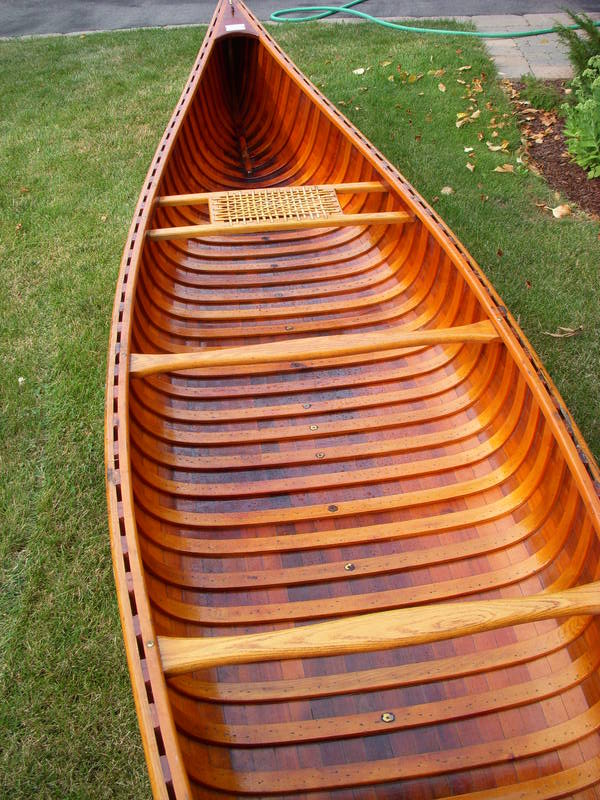
Turns out the cedar canvas canoe I obtained in a trade isn't a likely Chestnut Chum at all. Mike Elliot of Kettle River Canoes mentioned in a comment that the canoe wasn't consistent with a Chestnut. Instead it looks to be similar to a Richardson or Rilco based on the narrow red cedar planking and other features

Richardson and Rilco were descendents of Lakefield Canoe company. According to the ID page on Dragonfly canoe, in 1962 Jack Richardson, the former General Manager of the now defunct Peterborough Canoe Co. purchases the Lakefield Boat Co and renames it Richardson Aquacraft, also called Rilco Industries. The company closed down around 1969. The narrow red cedar planking is an identifying feature of this style of canoe.

Intrigued, I did some more searching and came across this posting on Kijiji for a fully restored Richardson. The planking pattern is neater but similar to mine.


Richardson Canoe


Despite the fact that the rawhide seats had long ago deteriorated on my canoe and had been replaced with simple plywood planks, the underside of the seats revealed a curious hole pattern to the seats - basically a line of offset holes. This pattern is also found in Richardson / Rilco boats.

Babiche weaving pattern with offset lacing holes

It would seem that my canoe has many features of this style made by a less experienced or a rushed builder. So for now I'm calling it a Richardson copy-cat.

Regardless of the history of the boat, I've already had lots of fun poling and paddling her and am eagerly looking forward to my own attempt a basic restoration.


Newer Posts Older Posts Home Page