
Penobscot Wood Paddle (mid-19th century)
poplar; length 75 in.
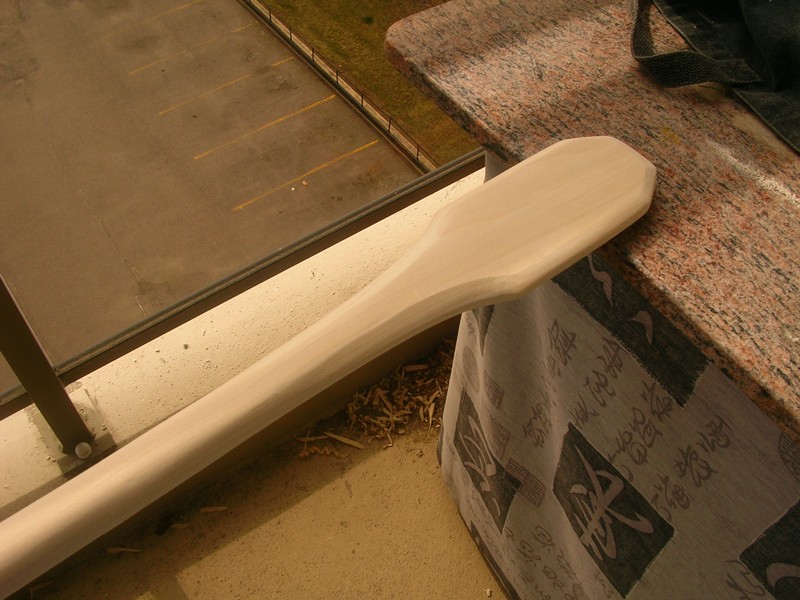
The beveled, triangular grip gracefully transitions to a round shaft and teardrop-shaped blade; surface with warm patina

Grip Closeup





 Warren's Canoe Paddles book has a outline sketch of one particular North West coast paddle made from the Nootka People, more correctly known as the Nuu chah nulth. It is a peculiar in that it has a large area, sweeping blade that ends in a protruding tip and a long, flattened shaft region with roll-style grip. The few online versions I've been able to find are high end artworks decorated in the amazing style of the region. On the right is an example I found on the Inuit Gallery of Vancouver website (Scroll down in the Northwest Sculpture section to find it). The paddles details:
 As for decorating, I wanted to maintain the native decor and ideally burn a Raven image, seemingly appropriate for this work. Months went by before any suitable idea could be found. On my last visit to Canadian Canoe Museum in the fall of 2007 (can't get enough of that place), I took a shot of some Haida paddles on display with a dugout canoe. I really liked the 2nd paddle from the top, an elongated raven image.
  A few days later, I was reading a back issue Canoe Roots magazine (Fall 2006), where there was an article discussing Kirk Wipper's history of collecting canoes that ultimately formed the basis of the museum today. In it was pic of a Haida canoe with an identical Raven image painted on the bow. Check out the specific page on the online archive here. So I burned this image, flipping the orientation so that the "beak" of the bird pointed towards the tip while adding some extra background markings on the blade. By burning at high temperature, the wood was charred almost black, nearly mimicking the effect painting with black acrylic. Here are the results:

 I've been on a couple kayaking day trips which have been great, but I'm much happier kneeling in a canoe with a single blade paddle controlling all the movement. The sitting position in a kayak wreaks havoc on my back. Put me in a canoe on the other hand, and I can kneel on my heels for hours without discomfort. Given the popularity of kayaking over canoeing in recent times, I guess I'm in the minority. In addition, I've always found that the feathered, euro blade, plastic paddles used in modern kayak touring seem designed just to scoop as much water as possible to power you through the water. They've always been too cumbersome for underwater recoveries and finesse strokes to propel the watercraft. The simplistic but graceful lines of the Greenland Inuit kayak paddle on the other hand, seems much more ergonomic and suited to the task of long distance paddling and given my new found woodworking confidence with the single blades, I thought I would give a shot at making one.
 I started off with a trip to Century Mill for some new stock. I ended up getting some maple, poplar, and walnut pieces jointed and planed into 1 1/8th strips. I chose this dimension because this is also the size for my canoe paddle shafts and wanted to have some for intended laminated canoe paddles down the road. I also scored some very affordable walnut and maple pieces by rummaging through their "shorts" pile...discarded pieces cut from other stock. In many cases, these were perfectly suited to rip into strips to form blade or grip areas. At up to a 70% discout these were great deals on otherwise "discarded" wood.
 There a many debates about the best adhesives with most people siding with epoxy. But given that this was my first attempt, I didn't want to get jugs of the mixing formulas in case the experience was a bust. Also, epoxy cures so hard that it can blunt hand tools quickly so I opted for a waterproof polyurethane glue (Gorilla Glue) that seemed appropriate for water-based application like a paddle.


 Shaping the blade was a breeze after working on the larger, irregular shaped canoe paddles. A simple cambering process and general tapering of the blade resulted in a paddle I was quite happy with. Carving the shaft (loom) of the paddle followed the same logic as a canoe paddle, except I used a rasp to slightly angle where the walnut blades met the poplar core, resulting in tiny "shoulders" where one grips the paddle during use.Most sources also mention rounding the tip into a semicircle shape, but I felt that the whole angular and linear shape of the paddle would be broken by this, so I left the edges straight.







 Email this post
