Showing posts with label Ash. Show all posts

Tuesday, November 22, 2016

William Armstrong Inspired Ash Paddle

It's been an enjoyable fall working on some more paddles in the backyard workshop. This next one was carved out of narrow plank of ash. The limitations of the board meant that this design would have a slender 4-1/4" blade. Had a chance to test this one out on the earlier Toronto Islands Daytrip to get a feel for it. The shaft felt a little too bulky so it was worked down a bit more.


Also finally purchased a cabinet scraper to help with the finishing stages. After multiple wettings it was scraped downed and then sanded with 320. Never really liked the open grain feel of ash but with this extra work, it is much smoother.

As for decoration, I felt like doing something simple and once again looked back into history for some inspiration.  A common theme seen in many historic paintings is a red checkered pattern on the paddle blade.

Paddle image from A View near Point Levy opposite Quebec with an Indian Encampment, Taken in 1788 
Thomas Davies (1737 - 1812)


Decorated Paddles from Indian Encampment near Amherstburg, c. 1819-1830
William Bent Berczy
Original Post Link


This paddle pattern is most apparent in multiple artworks by William Armstrong (1822–1914) that have been posted about many times on the site.


Paddle image from The Distribution of the Government Bounty on Great Manitouling Island 1856
William Armstrong


Paddle image from Indians Completing a Portage
William Armstrong
1873 watercolor


Paddle from Hudson's Bay Store, Fort William
William Armstrong
c. 1860-1870


Anyway, I had some left over Regal Red Tremclad rust paint left over from repainting the 14' Chestnut / Peterborough earlier in the summer so thought I would put it to use here. This oil-based waterproof paint doesn't need a topcoat of varnish which works well given that I prefer to oil all my paddles.

My older son was interested in helping so he assisted in laying out some tape. Painting has never been my strong suite or favoured medium and there's no way I could replicate the clean lines otherwise .


As an extra bit of decoration, I also painted part of the elongated grip...


It still needs to be oiled which will turn the plain ash into a much more golden hue but the weather outside has turned.



Tuesday, April 28, 2015

Luke M's current paddles

Paddle maker, Luke M from Wales (see previous post HERE) has sent in photos of some of his new carvings.  Here is a group photo showcasing his latest full sized paddle and a small child's paddle alongside his restored axe.


The smaller paddle was carved from a piece of felled ash and the carving axe has a 3 ½ pound double bit with a cleft handle made from the same ash tree as his previous batch of paddles.

The full sized paddle was carved from a harvested log of larch. It was carved completely by eye and the design was copied from the 1875 Passamaquoddy ocean canoe paddle in the Bark Canoes and Skin Boats of North America. It was finished smooth with a crooked knife and not sanded. Here are his photos of the paddle being roughed out with the axe and some finished views of it at a different angle to illustrate the grain.

Work in progress

All carved by eye


Beautiful grain pattern


Luke also sent in a photo of his two latest crooked knife blades. They are made from band saw blades. He used a forge made from two kiln bricks and a propane torch to make these, which he mentioned was an improvement from using a wood stove.


Thanks Luke for sending in your wonderful pics!


Saturday, February 1, 2014

Northwoods Ways Paddles

Came across some beautiful paddle pics from the facebook page of North Woods Ways. These are the creations of well known Maine Guide Alexandra Conover Bennett

White Ash Bow & Stern Northwoods Paddles


Algonquin Style paddles patterned after an Omer Stringer Blade

Feb 2020 Update: Alexandra has retired from paddle making but North Woods style paddles are now being offered by Shaw & Tenney Co. Read more at this post HERE.


Tuesday, December 6, 2011

Peter Polchies Ash Malecite Replica - Part 2

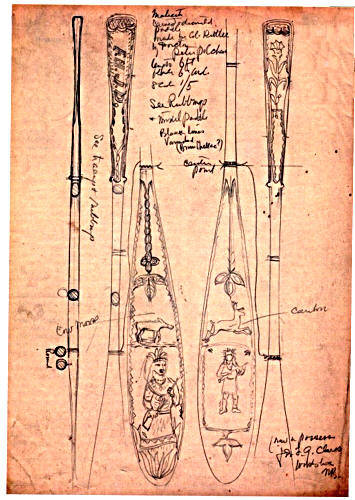
The ash Malecite I'd been carving was sanded down and ready for some decoration. For this one, the intention was to replicate the pattern from one of Tappan Adney's famous sketches of Malecite Paddles...specifically the model on the left.


Adney's sketches of Peter Polchies' carved paddles

Adney's scribbled notes mention that the paddles were made by "Doctor" Peter Polchies for a Lt. Col. Herbert Dibblee. Curious to learn more, I found out that Dibblee was a famous resident of Woodstock, New Brunswick. His full name was Frederick Herbert Jenkins Dibblee which would explain the initials F.H.J.D. inscribed on the grip.

Lt.Col. Dibblee is also mentioned in passing in Adney's text, Bark Canoes and Skin Boats of North America on page 75...

"One of the later developments took place on the St. John River, in New Brunswick, where two Indians, Jim Paul and Peter Polchies, both of St. Marys, in 1888 built for a Lt. Col. Herbert Dibble of Woodstock the racing canoe illustrated above (fig. 66)..."
I can't seem to date Adney's sketches and there isn't mention of date the paddles were made but it seems plausible that they were carved to accompany this Malecite racing canoe which would date them to 1888.

The paddle I was replicating featured a recurrent vine motif as well as images of a cow moose and a hunter. Ruth Phillips' book, Trading identities: the souvenir in Native North American art from the Northeast mentions that many paddles were carved with basic scenes such as hunters, game animals, equipment. In this way, these paddles might be similar to the Malecite Paddles ones in the British Museum featuring similar "vignettes" of native life.

After free handing the image as best I could, the design was burned in with my pyrography unit. This was the first time I've done any woodburning decorating with ash - not really the greatest wood for pyrography. The open grain structure and relative hardness of the wood makes it burn very inconsistently and the result is quite a speckled and splotchy look. In the end it worked since the original sketch diagram wasn't crispy clean either. Instead of Lt. Col. Dibblee's initials originally scribed onto the grip, I ended up burning my son's initials to give this paddle a little more sentimental value. Here are some shots.


Replica Blade and Modified Grip


Peter Polchies Replica Paddle


Wednesday, November 16, 2011

Peter Polchies Ash Malecite

After obtaining my recent batch of lumber, I've eagerly begun carving again. In this case I wanted to try carving a wood I haven't yet worked with...ash. While I've finally acquired an old 12" bandsaw (hand-me-down from my Dad's old shop), it's been setup up north in the Cottage garage. I'm stuck in the city until the Christmas holidays so figured I'd try shaping ash plank the old fashioned way with an axe. This creates a lot of waste chips from an otherwise usable board, but this plank was quite narrow (just a bit over 4.5 inches wide) and ash isn't too premium a wood around these parts.

For this paddle, I wanted to try and replicate Tappan Adney's Malecite paddle sketches which appear at the back of John McPhee's famous canoeing book, Survival of the Bark Canoe. Adney's scribbled notes mention the paddles were carved and decorated by a Doctor Peter Polchies and were 6ft long with a 6inch blade. I intend all my paddles to be users so the dimensions were reduced to fit my preferred length of 58" with a narrowed blade width to accomodate the ash board.


Adney's sketches of Peter Polchies' carved paddles

After marking out the shape on the rough lumber, I made a few stop cuts with the saw and commenced hacking away. Now that we have a backyard instead of a condo balcony there's much more space and enjoyment to be had.


Paddle waiting to emerge


Sawing stop cut


Chopping away

Still not totally competent to chop right along a fine pencil line, so I stopped with the edges of the paddle looking a little ragged. They can easily be cleaned up later. A little trick I learned is to leave a few inches on the top and the bottom of the blank until the very last minute. Makes it much easier to handle the blank when wielding the axe.


Chopped out paddle blank

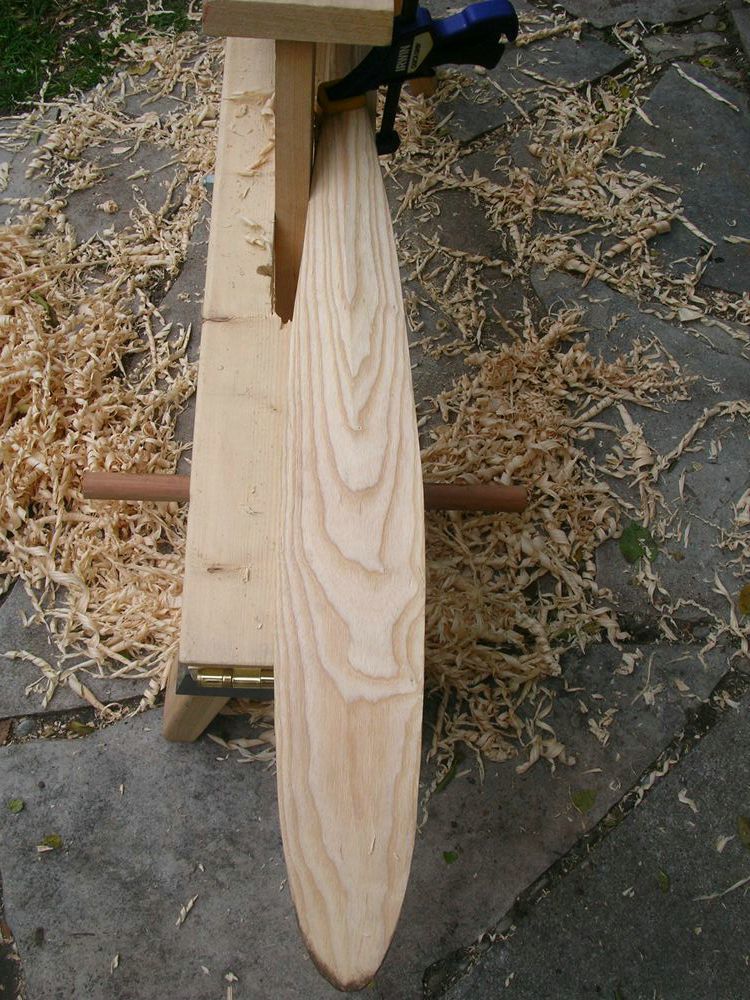
After thinning out the blade face with more axe work, I set up my portable shaving horse made way back in '08 that's still serving me well. Quick work with the spokeshave and the blade & grip were coming along nicely. Ended up with a pretty nice piece of ash - the grain isn't too difficult to work with and the pattern on one side of the blade is quite appealing. The whole paddle was thinned out quite a bit with the shaft thickness reduced down to 1" to make the whole thing light & flexible.


Set up on the horse


Grain pattern on the blade

I've purposely left the grip area a bit bulky to be true to the sketch and because of the fact that bulkier grips suit my palm just fine


Carving done

Decoration post to follow...

December 12, 2011 Update: Decoration is complete...see part 2 here


Older Posts Home Page