Showing posts with label Adirondack. Show all posts

Sunday, January 12, 2020

mid-to-late 19th Century Adirondack Paddle with carved drip ring

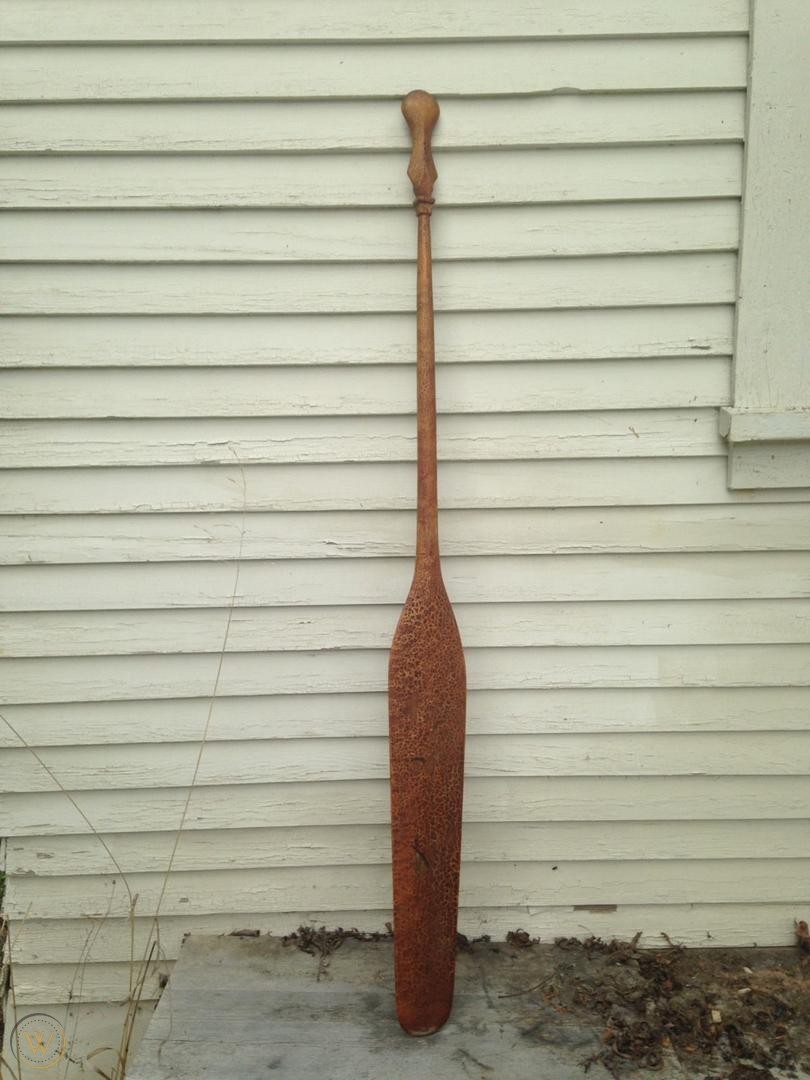
A dated listing on WorthPoint.com showcases an antique Adirondack Guide paddle with a heavily cracked, but beautiful patina and a unique grip shape.

Adirondack Guide paddle
54 inches

The rounded grip handle cascades to an arrowhead motif atop a square shaped drip ring...

Grip Closeup



Sunday, March 24, 2019

Tom P's Adirondack & Folk Art Paddles

Blog reader Tom Penniston is parting with two of the better paddles in his personal collection.

The first is a 56 inch long Adirondack steering paddle identified as being made by the 19th century guideboat builder, A.H. Billings. The grip and motif are identical to the Billing's paddle now in the collection of the Adirondack Museum (Item 1971.163.0002) originally from Clark’s Camp on Blue Mountain Lake. Tom's paddle is made from bird's eye maple which has aged to a lovely patina.  The rounded grip is shaped above an arrowhead-style carving. At the base of the grip, the initials "E K" are etched into the wood.


Tom also has a full-sized 65 inch Seth Steward (1844 - 1927)  folk art paddle. Steward was a Maine artist who frequently painted on smaller souvenir canoe paddles, many of which featured the long, flat grips of the Northeast Region (see example in this earlier post from 2010). A  biographical writeup with more samples of Steward's work can be read on the Cherry Gallery Journal. A full-sized Steward paddle is a relatively rare find in the paddle art world.

Anyone looking for more info on this rare piece of folk art and/or the Billings Adirondack paddle can contact Tom directly via email.


Thursday, September 7, 2017

TAUNY Adirondack Paddles - Ted Comstock Personal Collection

Missed this event until it was over, but TAUNY - Traditional Arts in Upstate New York had display of vintage Adirondack guideboat and canoe paddles from the collection of Ted Comstock. The paddles feature various blade shapes and unique grip designs including a few with the "lollipop" style...

Ted Comstock Paddle Collection


Monday, March 21, 2016

Adirondack Steering Paddle and Oar

From LiveAuctioneers.com, what looks to be an incomplete Adirondack guideboat set consisting of a steering paddle and a single oar...


Lollipop Grip Steering paddle and Single Oar


Closeup of Lollipop Grip 


Wednesday, December 16, 2015

Circa 1900 Adirondack Steering Paddle

LiveAuctioneers has another post-auction listing of a unique Adirondack Steering paddle featuring the distinct diamond grip style.

CIRCA 1900 CANOE PADDLE WITH MOUNTAIN LION
Surface decorated with (2) stars and mountain lion.
Length 67 inches


The polished and slightly worn grip has an oval, egg liked top grip with the flattened diamond section decorated with a star motif...


While not fully visible in the overall paddle view, there is a burned decoration of a mountain lion on the blade.


Many other Adirondack paddles have been featured on the site before (see other posts here). For those who might have missed it, Dr. Gordon L. Fisher published an excellent book back in 2008 thoroughly discussing the interesting history of the paddles in this region.


It also features detailed plans and woodworking tips for carving replicas of surviving Adirondack paddles in museums.  Downloadable PDF excerpts provide a preview of the content.


Friday, November 20, 2015

Ebay Dragon Fly Diamond Grip Paddle

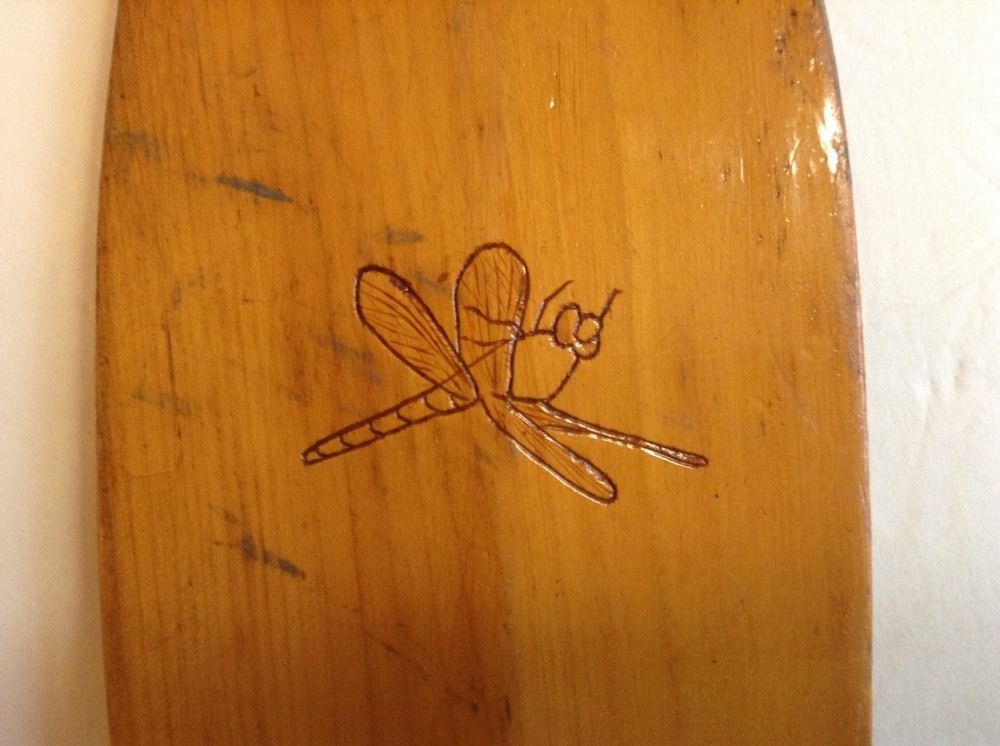
Blog contributor Luc Poitras just notified me of a unique looking paddle up for sale on Ebay. The listing shows various angles of the paddle which feature a strong spine down the blade and a tiny burning of a dragonfly.


The grip features a very interesting design as well - a sort of oval top with diamond or arrowhead lower section commonly found in Adirondack style paddles. Here are a few more of the seller's photos...


Sunday, April 8, 2012

Ca. 1900 Adirondack Guide Paddle

A monthly favourite of mine, the current items (April) at the CherryGallery.com features a circa 1900 Adirondack Guide Boat Paddle with an interesting spined grip. This seems quite different from the circular "lollipop" grips seen commonly in this unique paddle design


Adirondack Guide Boat Paddle
This maple guide boat paddle has a roll-top handle with a prominent center ridge, and a gracefully tapered blade.
Circa 1900
5" w, 70.5" h


Monday, January 9, 2012

ADK Auction Paddles

The Flickr page of the Adirondack Museum has some great images from their 2011 auction. A few paddles were featured in the collection


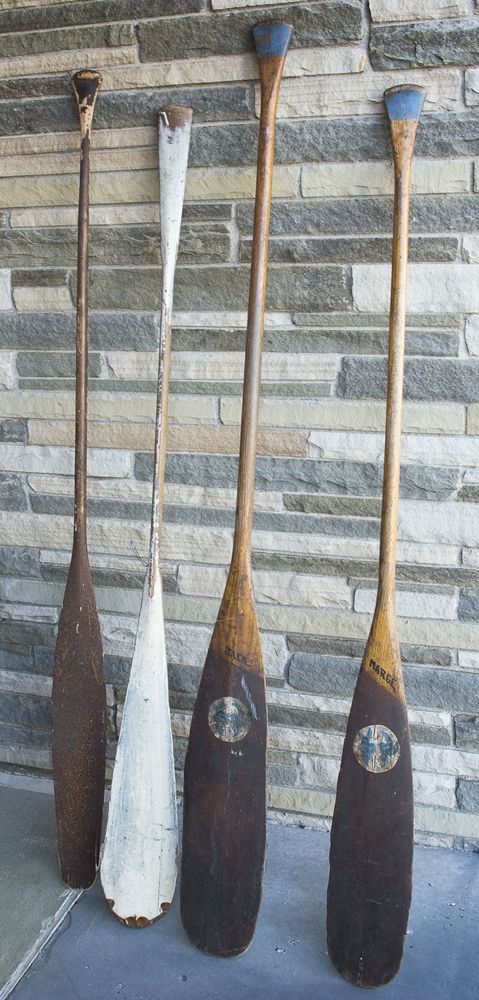
The white painted beavertail guide paddle above (2nd from left) has a copper (or maybe brass) tip protector. A while ago, I wrote a post about these vintage paddle accessories which seem to have fallen out of favour with paddle makers today.


Wednesday, February 2, 2011

circa 1900 Adirondack Paddle

Thanks to the winter storm hitting my region today (which really isn't that bad in my opinion), my workplace has cancelled all classes...this means a SNOW DAY and a chance to post another paddle picture. This one is from February's "Current Items" page at the Cherry Gallery which features a nice looking Adirondack paddle.


Looks like it has already sold. The details from their site...
Adirondack Guide Boat Paddle
This guide boat paddle has a characteristic elaborately carved diamond-motif handle and a long, narrow blade. The front of the blade is painted with the four playing card suits - perhaps the guide was a gambler...
Circa 1900
5" w, 58.5” h

The carved motif area below the circular grip adds a nice decorative flair to whole piece. Here's another angled shot showing this interesting Adirondack feature.


Diamond Motif on grip


Sunday, November 7, 2010

Cherry Gallery - Adirondack Guide Paddle

November 2010 current items at the Cherry Gallery features an Adirondack Guide Paddle circa 1890...

A delicate cherry guide boat paddle with a lollipop top and a diamond shaped and chamfered upper shaft. Good original surface, with minor damage to one edge of the blade.
Circa 1890
4.75" w, 66" h
$1,200
The "lollipop" grip the description refers to is similar to a historic one documented in Dr Gordon L Fishers's 2008 publication Guideboat Paddles: An Adirondack Treasure. Specifically, it resembles the grip design popularized by Adirondack Guide and Boatbuilder, Caleb Judson Chase and is often referred to as an Arrowhead Motif grip.


Arrowhead Motif

An online excerpt (.PDF format) of Fisher's book has some photos of the author carving out this interesting grip shape (see last page of excerpt - pg 60). The book has a nice schematic of this grip design with a table of offsets for the blade in the appendix section. I'm planning to get more lumber stock in a few weeks and figure I'll attempt this new grip design as a winter project.


Thursday, August 12, 2010

Paddle Auction for Cancer

Back at the MEC Paddlefest in June, I met David Donaldson, who was displaying his homemade stitch and glue kayak and had intentions of making his own greenland style paddle. We've been in touch since and he let me know about his efforts to raise money for Cancer Research with the Annual Kayak for a Cure Event in nearby Mississauga, held this year on September 18th.

In support of his cause, I've donated one of my paddles to be auctioned off - the walnut-poplar Adirondack style paddle.


Whole Paddle; Barred Owl Decoration

More details about this event and David's efforts can be found on his Fundraising Site which includes mention of bidding by email to Ontario@kayakforacure.org


Wednesday, July 7, 2010

Adirondack Museum Antiques Show

The Adirondack Museum in Blue Mountain, NY, is featuring an antique show on August 14-15, 2010. A pic from their event page shows some paddles featured in the sale.


Antique Paddles from the Cherry Gallery

The set includes some interesting Northwoods style paddles with elongated grips. In particular the largest paddle on the far left has a grip shape reminiscient of the grey painted Penobscot paddle sold by Summer Antiques in Lake Placid, New York.

The painted red paddle has in interesting sculpted grip shape and while I'm not a big fan of painted paddles, this one stands out for whatever reason. A few feature some interesting etchings and pyrography and the tiny dark paddle (3rd from right) has a spherical grip very similar to basic Adirondack Guide paddles.

For those in the area, this might be an fascinating event to check out. Here's some additional info from their site.
The Antiques Show and Sale will feature, vintage Adirondack furniture, historic guide boats & canoes, genuine Old Hickory, fine art, Native American jewelry & artifacts, folk art, Oriental & Persian rugs, Olympic advertising, camp & trade signs, taxidermy, books & ephemera for the collector, and everything camp and cottage. Managed by Rod Lich, Inc.


Tuesday, October 20, 2009

New Paddlemaking Book - Adirondack Guide Paddles

In my never ending quest to learn more about unique paddle designs, I stumbled across the page of Dr. Gordon L. Fisher describing his recent (2008) publication, Guideboat Paddles: An Adirondack Treasure. Available online is a PDF format excerpt from the book that shows some black and white photos documenting grip carving. Intrigued, I ordered a copy and recently received it in the mail.

Single blade Adirondack style paddles are quite a speciality in the paddling community. Their usage and history localized to the Adirondack region of New York state. My knowledge of guideboats in general was quite limited having assumed that they were exclusively rowed with oars rather than propelled with single blades, but an informative opening section in the book describes how many guides would silently maneuver the guideboats with single blade paddles as their sporting passengers would hunt deer and other game. Often, while one person powered the craft with oars, a helmsman would steer the boat with a single blade from the stern. Single blade paddles were therefore quite functional with guideboat touring.

The truly interesting feature of the paddles, however, are the circular grips. The book details some of the surviving historical paddles now at the Adirondack Museum and provides plenty of computer generated sketches and technical details necessary for reproducing the unique handle designs. Offset data as well as fullsized portions of the blade curves make reproduction a breeze. From a canoeing persepective, the narrow, straight sided blades would serve well for solo paddling, although the length of the paddles (and proportional blade lengths) would need to be reduced , especially when kneeling. Other than that, these are some designs I intend to replicated soon.

What I thoroughly enjoyed about the book, besides the plentiful illustrations and photos, was the historical context of each of the museum paddles described in the text. To many, a paddle is just a utilitarian object until a story is attached to it and its history revealed. All in all, I thoroughly enjoyed Gordon's contribution to the paddle making community and hope to make a trip to the Adirondack Museum one day and check these unique designs out with my own eyes.


Sunday, September 13, 2009

Another Adirondack Guide Paddle

Another Adirondack Guide Paddle for sale by the folks at Summer Antiques. The grips on these paddles are so unusual. A previous post shows off some more of their selection which haven't been sold by the looks of things.


Monday, January 12, 2009

Adirondack Guide Paddles

Summer Antiques in Lake Placid New York has some interesting paddles posted on their site including the following collection of Adirondack Guide Paddles with very interesting spherical grips


Assortment of Adirondack paddles


Adirondack Guide Grips

Also in the store is a Penobscot style paddle with a scalloped, step styled grip. It looks to have been painted and is now faded to a dreary grey colour. Personally, I wouldn't paint the whole paddle in such a manner, but perhaps the original owner used an oil based paint as a sealant instead of having access to spar varnish.

Penobscot Paddle

To top off the collection, check out this Abenaki Birchbark canoe (circa 1895). Looks to be in great shape with a nice patina on the faded bark.


c. 1895 Abenaki Canoe


Tuesday, April 1, 2008

Laminated Adirondack Guide Paddle - Part 2

When I last blogged about this paddle, I had come across a significant structural fault in the flattened grip area. A large crack filled with soft, punky wood emerged after shaving and sanding this area from its original 1 1/8" thickness. To "save" the paddle, a little emergency epoxy repair job was in order...the 1st time I've attempted something like this.


Dead wood crack & applying epoxy

After letting the epoxy set overnight, it was time to begin the vigorous process of sanding it down. Luckily, the direct sun on the balcony made working outdoors a very pleasant affair. I had to strip down to my undershirt because the sanding action warmed me up quick. Made for a fashion faux-pas photo especially with our now dead (but once highly productive) tomato plant in the background.


After checking out the grip, the bulbous palm area didn't quite agree with me, so I shaped it down to a more traditional triangular shape using some rasps. Pretty easy now that the area had been extensively thinned.


Before and After shot of shaping the grip


The different shaded walnut strips used to make this paddle gave the blade a bit of a streaked look. This reminded me of a time when I spotted a Barred Owl while paddling the Oxtongue River (just beyond the Western boundary of Algonquin Provincial Park on a day trip last year. Couldn't take a proper photo because while paddling a river solo with a significant current, my bird watching is limited to a quick use of binoculars with one hand while trying to brace the canoe with a paddle in the other. Unless I'm resting in a nice eddy, photos are tough to manage. Anyway, this stock photo shows the streaking pattern on the bird that I figured would blend with the walnut on the blade. Thought I would add some Eastern White Cedar leaves as an accent as well as a native inspired owl image (may sand off...not entirely happy with it) on the grip face.


Burning the blade & native owl on grip

All seemed well except that compared to the wonderful tight grain of Birch used for the Omer Sapsucker Paddle, the open grain of the Walnut & Poplar made for uneven burning and many blotchy spots. Not my best artwork but ultimately I was left with a pretty decent, extremly light, and very flexible paddle made from strips from the scrap pile. Can't wait to try this one out once the spring thaw hits and the cottage lake is open again.


Plain & Decorated Sides


May 5/08 UPDATE: This paddle has now been varnished. View it here.


Friday, March 21, 2008

Laminated Adirondack Guide Paddle - Part 1

While searching the net for different paddle designs, I came across a pic of two Adirondack Guide paddles and liked their look. Their distinguishing feature was a combination pear grip with an extra flattened area encompassing almost half the shaft length. The only other time I've seen this close up is with Turtle Paddle Works' Whip-Poor-Will paddle, but that one comes with a narrow beavertail blade. Instead, I opted to keep the shaft style but use the 28" Algonquin pattern blade listed in Gidmark's Canoe Paddles book.

This paddle was made up of extra strips I had on hand from my attempt at the laminated Greenland Kayak paddle made back in the fall. Just like that one, the canoe paddle would be made of a Yellow Poplar (Leriodendron tulipifera) shaft from a pre-planed 1 1/8th inch strip (cut to 58") and a blade of Black Walnut (Juglans nigra) waste pieces. The photo sequence below shows the pieces lined up before cutting as well as the final orientation before gluing the blade. The 8ft long walnut strip (which was quite warped) was cut into 30" pieces for lamination against the poplar shaft and remaining bits of scrap walnut (one side square) were used to complete the blade. In the end, the width just measured that of the Algonquin style blade pattern at its widest point (5 1/4").


Leftovers for materials; Alignment; Dry Clamping & marking out of blade

The grip area was made with additional walnut waste pieces lying around and were oriented in such a manner as to be able to carve a regular mushroom head grip with a flattened extension of the upper shaft. Another board covered in waxed paper and setup on sawhorses served as the laminating beam. The strips were glued up with my usual adhesive, Gorilla Glue and clamped for 24 hrs.


Grip pieces; Wax paper laminating beam; Clamping & glue up

In the end the blank looked quite odd with all the waste pieces glued up, but it was more the sufficient to make a full paddle from these "scraps" so as not to waste the wood. While maybe not as aesthetic as a one-piece, it certainly allows for a more eco-friendly use of this precious resource. The actual paddle shape still needed to be cut out from the glued blank and that was done as part of my earlier post on the visit to The Carpenter's Square Do-It-Yourself woodshop.


Glued up blank & cut out paddle

The cut out paddle has been a breeze to plane and shave thus far. In one evening, I was able to do the work that nearly took 3 days on the Omer Birch paddle. The reason for this was because BEFORE the glue-up of the strips, I had lightly tested the grain with the spokeshave to ensure that all the strips aligned with the grain in the same direction. This way, the strokes would not need to be reversed when passing over the walnut & poplar, a mistake I had corrected from my earlier time-consuming error on the Laminated Jay Ottertail. From now on, every laminated paddle I intend to make will go through this initial test to save on the shaving time.

For the grip, I intended it to be a modified mushroom head style (like on the Walnut Kingfisher) with an flattened section to give the paddle more flex. Shaping involved cutting two grooves with a round rasp on either end, spooning out the wood between these indents, and then using the round rasp again to undercut the head of the grip in a slightly curved pattern. By shaping the undercut backwards like this, I could stop to check for feel and ensure I didn't remove too much wood. The pics below show the rough job, although I signficantly cleaned up the work since taking these shots. Don't know why the photos resulted in a blue tone, but in the 4th image you can spot a reddish smudge on the grip face. While holding onto the grip area, I scraped across three fingers on my left hand with the rasp - a careless and painful mistake that tore off layers of skin while smearing blood all over the shaving horse and onto the paddle grip. I guess now I've formed a blood-bond with this one.


Carving the grip

With bandaged fingers unable to bend at the knuckle because of my thoughtless mistake, I thought I'd begin the sanding phase on the bulk of the paddle using the orbital sander. All this while Toronto experienced another massive snowfall with -16 Celsius windchill. So I bundled up and did some work outside.


Initial sanding with the ROS

This revealed a major crack with soft dead wood in the walnut when I sanded down part of the flattened grip. I had some left over Epoxy from the knife making kit and figured that by filling the knot with epoxy and then sanding it down, it would prevent the crack from spreading and the dead wood from chipping out. Time will tell if I made the right decision here.


Epoxying the crack to strengthen and prevent weakening


This is where I am now...final sanding, shaping, and repair. Stay tuned for the second part of this post which will have to wait until I can remove the bandaids on my three injured fingers.


April 1/08 Update: Part 2 of the post now online.


Older Posts Home Page