Showing posts with label Mi'kmaq. Show all posts

Friday, January 3, 2025

Tom Penniston's paddle acquisition: Rare decorated Mi'kmaw paddle

Some of the paddles in the private collection of Tom Penniston have been featured on the site. Tom was fortunate to recently acquire another spectacular pieces and has graciously allowed posting pics and details. This one has etched decoration on both sides of the handle but ink/dye drawings on one side of the blade. Dr. Roger J. Lewis, Curator of Mi’kmaq Cultural Heritage at the Nova Scotia Museum, has confirmed the paddle's origins as "definitely Mi’kmaq".

 
Decorated Mi’kmaq paddle


The grip also has a relatively unique style of roll grip that protrudes on one side but is flat on the other.
  
Etched decorations on grip


Ink artwork on blade


The non decorated side of the blade features an inscription with the first two lines reading:
"Made in gravel Pit yarmouth co ns"
" Mrs. L. Luxey made"

Gravel Pit Reserve was situated within Yarmouth county in southern Nova Scotia with the territory now forming part of Acadia First Nation. According to  Dr. Lewis, the Mrs. L. Luxey referred to in the inscription may be Mary "Lucy" Luxey (1855-1938) wife of Louis Luxey, chief of the Reserve. Unfortunately there is no date inscribed on the paddle  but if indeed it as was made by Mrs. Luxey as the inscription infers, it may one of the very few known examples carved by a female carver. 

Further proof of the Mi'kmaq  origin may be in the last line of the inscribed text. The first two words might be read as "al nu". Although the term Mi'kmaq is predominantly used by the tribal group today, another term used to refer to themselves in their own language was  "al nu" or sometimes phonetically written as "el nu". Much later in the mid-20th century the rules for writing were formalized and today the term is written as Lnu  or L' nu meaning "the people". Today, some of the reserves have the word Lnu in the name of the territory. As of yet, the rest of the phrase hasn't been translated. 



Sunday, January 21, 2024

Historic Paddle Photo: 1872 Mi'kmaq paddles

A very old image posted on Facebook showcases two Mi'kmaq men next to their bark canoe. Difficult with the tones in the background but you can just make out the shape of the long paddle blades. The source identifies the men as John Barrington and John Stevens (aka Big John) in Newfoundland, Canada dated to 1872.


Saturday, November 16, 2019

Royal Trust circa 1860 Mi'kmaq Paddle Reproduction

The British Royal Family has recently consolidated all of their acquired artworks and historic gifts into a new collection called the Royal Collection Trust. Included in this monumental global collection of artefacts are First Nations items gifted to various royal members during their visits to Canada.

A fascinating set is a Mi'kmaq sourvenir bark canoe that came with two dolls, two pair of paddles, a fishing spear and miniature basket. The set was presented then 18 year old Prince Albert Edward (the future King Edward VII) during his first visit to Canada in the summer of 1860.


Mi'kmaq Model canoe and dolls  1860
RCIN 84332
Royal Collection Trust
© Her Majesty Queen Elizabeth II 2016


The paddle set showcases two similar designs which look like two larger stern paddles and two smaller paddles with pole grips used by the bow paddler. Both feature a pointed spear-like tip


Mi'kmaq model paddles 1860
RCIN 84332
Royal Collection Trust
© Her Majesty Queen Elizabeth II 2016


While the model canoe is obviously not a true replica, being decorated with dyed porcupine quills and lacking an accurate number of ribs, the paddles do match some existing artworks from the era.


Paddle Detail from Wigwams at Pointe de Levy, Lower Canada
ca. 1836
Artist:  Whitmore, George St. Vincent, 1798-1851.
Credit: W.H. Coverdale Collection of Canadiana


I decided to reproduce the larger stern paddles with the flattened grip section adjusting to my preferred paddle length and scaling the grip width down to more realistic dimensions. The spear tipped blade is very quiet in the water compared to wider blade tips creating much less splash during each paddle stroke. As the originals were left un-decorated, I simply burned the paddle details into the face of the blade.


Tuesday, September 4, 2018

Historic Paddle Illustration: Digby Mi'kmaq Canoe Photo

The free online library at Archive.org has a great book outlining the extensive history of the Native culture on the East Coast.  Twelve thousand years : American Indians in Maine by Bruce J.  Bourque is a thorough publication that features some photos beyond just the Maine border to include First Nations groups from Canada. Among one particular shot in the appendix section is photo A-18 featuring a Mi'kmaq group with canoe in front of a bark wigwam. 


The two standing gentlemen at the far right and far left are each holding up an inverted paddle clearly showing the shape of the blade.


April 2020 Update: The three men standing in the photo have been identified as (Left to Right): Malti Pictou, Jerry Lonecloud, John McEwan, all noted canoe guides. The image source is from the Nova Scotia Museum, photo by Harry Cochrane or Ralph N. Harris, NSM 97.31)


Saturday, January 27, 2018

Circa 1850 Mi'kmaq Paddle Replica

Another historical paddle replica I've been excited to work on is from a circa 1850 painting by an unknown artist. One version of this artwork was acquired by the National Gallery in 1957 and was simply titled "Micmac Indians".


"Micmac Indians"
Unknown Artist, circa 1850
oil on canvas
45.7 x 61 cm


The image has been reproduced in many books over the years and was even replicated for a Canadian Postage stamp in 1973 . As an additional side note, the work has been praised by Mi'kmaw Historian and Ethnographer, Ruth Holmes Whitehead, as being a fairly accurate reflection of material culture for the period.


Back in 2015, another version of this scene went up for auction in London (see post here) as part of the Peter Winkworth Collection of Canadiana. This oil had a more extensive title but it is believed to painted by the same unknown artist.


Mi’qmak Indian camp on a bay with Mi’qmaks shooting Canada geese
ca. 1850
Artist: Unknown


A closeup of the male hunter on the bottom left shows a paddle resting across the gunnels of the humped canoe. The slender shaft has no discernible grip on the end and the wide paddle blade features a distinct scroll pattern.


The other paddlers also hold slender pole grip paddles with recurved blades and additional curved motifs for decoration. Each of the paddle shafts looks darkened or scorched compared to the relatively light coloured blades which gave me the inspiration to replicate the pattern with pyrography. My paddle was carved out of basswood, not a traditional paddle wood for the region based on surviving samples, but one that would be easy to shape and burn.

Going back to basics, I hacked the blade shape out with an axe to capture the essence of paddle making from this era. The slender shaft was finished with a crooked knife but I had trouble carving out the centre of the wide blade with this tool, so resorted to using a spokeshave for the tricky parts.

I burned the shaft evenly with the garden torch and finished the decorative curves in a darkened burn with a pyrography pen. With some eerie winter light in the backyard, I took a photo of the paddle leaning against the house wall.

Circa 1850 Mi'kmaq paddle replica

There seems to be a bit of mid-season thaw happening in Toronto. Our modest amount of snow has melted, but I'll be waiting until a proper ice-out before giving this unique paddle design a quick dip in some local waters.


Monday, November 20, 2017

Historic Paddle Illustration: 18th Century - Sauvages de la nation des Micmacks

Here's an 18th Century watercolour painting by an unknown artist depicting a Mi'kmaq couple in their canoe.

 French School, 18th Century
Sauvages de la nation des Micmacks dans leur canot d’écorce de bouleau; au détroit de Canso, entre la Nlle Ecosse en l’isle du Cap-Breton
inscribed as titled in the lower margin
watercolour on paper
9 ¼ x 12 ¾in. (23.4 x 32.4cm.)


While both paddle blades are submerged in the artwork, the long shaft and tiny grips are visible, as is the reverse handed technique of the paddlers.


Closeup of bow paddler

Closeup of stern paddler


Monday, November 6, 2017

1794 Mi'kmaq Canoe Model & Paddle - Musee Beaux Arts - Rennes

Found an image update of the the Mi'kmaq canoe model with decorated paddle at the Museum of Fine Arts - Rennes (original post here).


Modèle de canot avec rame
Inv 794.1.782
Museum of Fine Arts     RENNES


As mentioned earlier, the model was assumed to be collected by Christophe-Paul de Robien (1698-1756), a French ethnographer and historian. After the French Revolution, his personal collection inherited by his descendants was seized by the State and distributed to what became the Museum of Fine Arts of Rennes. During that inventory process, it was inscribed with a date of 1794 but the original construction date is likely earlier.

Accompanying the canoe is a single paddle with a pole grip and a decorated blade. Although faded, it appears that half the blade was painted with a red pigment creating a simple "yin/yang" effect.

Robien's curiosity collection is on exhibition at the Museum. A virtual tour and description (in French) can be read on this blog post here. Tucked on a bottom shelf is the canoe model with the dual toned, pole grip paddle displayed on top.


photo credit: Camille Janin


Monday, October 23, 2017

History Museum Mi'kmaq Canoe Display with Paddles

Mi'kmaw Canoe Builder Todd Labrador was commissioned to build a new 18.5 foot Ocean- Going birchbark canoe for the Canadian Museum of History (formerly the Canadian Museum of Civilizations). Photo documentation of the build as well as additional information can be read in this article here.

Haven't seen the museum display myself, but found a pic online which showcases the curious lines and construction style of these ancient craft. Hanging behind the canoe are two paddles which I was able to source back to the history museum's collection.


The top paddle (Object Code III-F-364) was made in 1992 by Mi'kmaw craftsman Rene Martin. The other weathered paddle below looks to be Object Code III-J-206, an Abenaki paddle with an unknown date (but prior to 1973).


Monday, October 16, 2017

Historic Paddle Photo: Fossil Rock - Dalhousie, New Brunswick

From the 1920 publication,  New Brunswick, Canada, available on Archive.org is this image of a Mi'kmaq bark canoe taken at Fossil Rock, Dalhousie New Brunswick.


 Paddle Closeup


Friday, October 6, 2017

Musee Civilisation de Quebec Paddles

The Musee de la Civilisation de Quebec (MCQ) has recently updated their web interface and online  database and they have some wonderful, full-sized paddles in their collection. The database required searching using the French words "pagaie" and "aviron" but revealed some antique designs of various tribal affiliations.


Abenaki Paddle
Mid 19th Century
 162.7 cm x 14.6cm


Huron Wendat
 159.2 cm x 11.7 cm


Lac St. Jean Innu
Inscription painted in dark beige and red:
LAC ST-JEAN 1889.
160.5 cm x 9.0cm


Malecite
Mid 19th Century
 170.2 cm x 16.7cm 


One unusual design is a square bladed Mi'kmaq paddle with different thickened shaft design at the midpoint, presumably to increase strength.

Square tip Mi'kmaq
Mid 19th Century
 145.0 cm x 13.8 cm


Monday, October 2, 2017

100+ Year Old Mi'kmaq Canoe - Fisheries Museum of the Atlantic

Came across an interesting article regarding a new exhibit at the The Fisheries Museum of the Atlantic  in Lunenburg, Nova Scotia.

At the centre of the new exhibit entitled "First Fishers" is a  15.5 ft birchbark canoe that was constructed by Mi’kmaq builders in the early 1900s.  Constructed from oak, spruce root, birchbark and iron nails, it was made by Steven and Newel Labrador around 1910 at the Mi’kmaq settlement in Paradise for the late Rice Whitman at the cost of $1 per foot.

The canoe was apparently used for hunting and fishing in the backwoods of Nova Scotia until 1947. Passing to his son and then his daughter-in-law, Margaret, the canoe sat untouched in the basement of the Whitman home for decades.  The beautiful looking boat has survived well over the century and appears to have come with two paddles.

1910 Mi'kmaq Forest Hunting Canoe


After doing a bit more research online, I came across the page of Grant Murray Designs who appears to have been the consultant for the exhibit. The canoe has been placed in a humidity controlled case and another paddle is mounted on the wall.

First Fishers Mi'kmaq Canoe
Image Source Credit: Grant Murray Designs


The grip profile of one of the paddles is just visible resting on the thwart of the canoe.

First Fishers Mi'kmaq Canoe
Image Source Credit: Grant Murray Designs


Monday, June 5, 2017

Musee de Beaux Art: Rennes canoe model & paddle update

From the Memoires Amerique Francaise website is another photo of the 18th Century Mi'kmaq canoe model at the Musees des Beaux Arts (Rennes) - see previous post HERE.  It  appears the one damaged end of the canoe has been repaired with additional bark. The two two toned, painted paddle blade is also part of the display.

 Canoe model and 1 paddle   
Inventory number : 1794.1.782 
Collector : Marquis de Robien 
 2nd half of the 18th century 
Source Link


Friday, February 17, 2017

Historic Paddle Illustration: National Maritime Museum Mi'kmaq paddle

The  National Maritime Museum, Greenwich, London has an historic illustration in its collection that might be relevant to those with an interest in traditional paddle designs.

Dated to 1750, it is thought to be the earliest accurate representation of a Mi'kmaq birchbark canoe. Included in the scale drawing is a pole gripped paddle with recurved shoulders and a pointed tip.

Description Scale 1:19.2.
A plan showing the body plan, sheer lines, and longitudinal plan for an 18ft bark canoe brought back to England for Lord Anson by Captain Henry Barnsley of HMS America (1749), in November 1750. The plan includes the outline of one of the paddles.
Date made 1750
Credit National Maritime Museum, Greenwich, London


Additional information on the backstory of this remarkable illustration is provided by an excerpt from Adney & Chappelle.
"The early English settlers of New England and New York were acquainted with the canoe forms of eastern Indians such as the Micmac, Malecite, Abnaki, and the Iroquois. Surviving records, however, show no detailed description of these canoes by an English writer and no illustration until about 1750. At this time a bark canoe, apparently Micmac, was brought from Portsmouth, New Hampshire, to England and delivered to Lord Anson who had it placed in the Boat House of the Chatham Dockyard. There it was measured and a scale drawing was made by Admiralty draftsmen; the drawing is now in the Admiralty Collection of Draughts, in the National Maritime Museum at Greenwich. A redrawing of this plan appears opposite. It probably represents a war canoe, since a narrow, sharp-ended canoe is shown. The bottom, neither flat nor fully round, is a rounded V-shape; this may indicate a canoe intended for coastal waters. Other drawings, of a later date, showing crude plans of canoes, exist in Europe but none yet found appear as carefully drawn as the Admiralty plan, a scale drawing, which seems to be both the earliest and the most accurate 18th-century representation of a tribal type of American Indian bark canoe."
Bark Canoes and Skin Boats of North America, p12 


Adney documented that Mi'kmaq and other Wabanaki canoes were well known for their elaborate ornamentation of winter bark. Shame that that the original Admiralty draftsmen didn't document if any such decoration existed on the canoe or the paddle, but that's not surprising since their obvious purpose would've been documented the lines of the hull.

For anyone interested in recreating this unique paddle shape, offsets for this paddle design can be found in Graham Warren's 100 Canoe Paddle Designs book.


Tuesday, January 3, 2017

Historic Paddle Illustration: Franquelin Map

One of the earliest representations of the distinctive shaped Mi'kmaq canoes comes from a beautifully illustrated map by Jean-Baptiste Franquelin (1651–after 1712).   Map for the Clarification of Land Titles in New France is dated to 1678. A portion of modern day New Brunswick shows three Mi'kmaq figures portaging their canoes while holding paddles in their hand.


Map for the Clarification of Land Titles in New France
 Jean-Baptiste Franquelin, 1678 


Two paddlers are seen carrying a canoe on their shoulders and another figure ahead of them is single portaging towards the coast.

Mi'kmaq Portaging Closeup


Also found another closeup image which shows the canoes and paddle shapes with more detail...


Thursday, November 17, 2016

Historic Paddle Illustration: Cockburn's Mi'kmaq Encampment at Point Levis

Here's another illustration of a Mi'kmaq paddle from a painting by James Pattison Cockburn. Mi'kmaq encampment at Point Levis, Quebec dates to around 1840. The foreground features a paddle leaning against a birchbark wigwam.

Painting | Mi'kmaq encampment at Point Levis, Quebec | M1821
Mi'kmaq encampment at Point Levis, Quebec
James Pattison Cockburn (1779-1847)
About 1840, 19th century
30.5 x 51.5 cm
Gift of Mr. David Ross McCord
M1821
© McCord Museum

It seems many artists chose to paint this location and made note of the Mi'kmaq encampments in the area. You can contrast Cockburn's rendition to two other artists by viewing this previous post.  In my opinion, Cockburn represented the paddle shape much more accurately.

Paddle Closeup

Tappan Adney illustrated what a typical Mi'kmaq paddle looked like in the mid-to-late 19th century after noting that earlier paddles seem to lack handles and just had a pole-style grip. Here's a Mi'kmaq paddle from Figure 59 in Bark Canoes and Skin Boats of North America.
Paddle from Figure 59
Bark Canoes and Skin Boats of North America  


Monday, November 7, 2016

Historic Paddle Art: Illustrated London News - Fisheries Exhibit Sketch

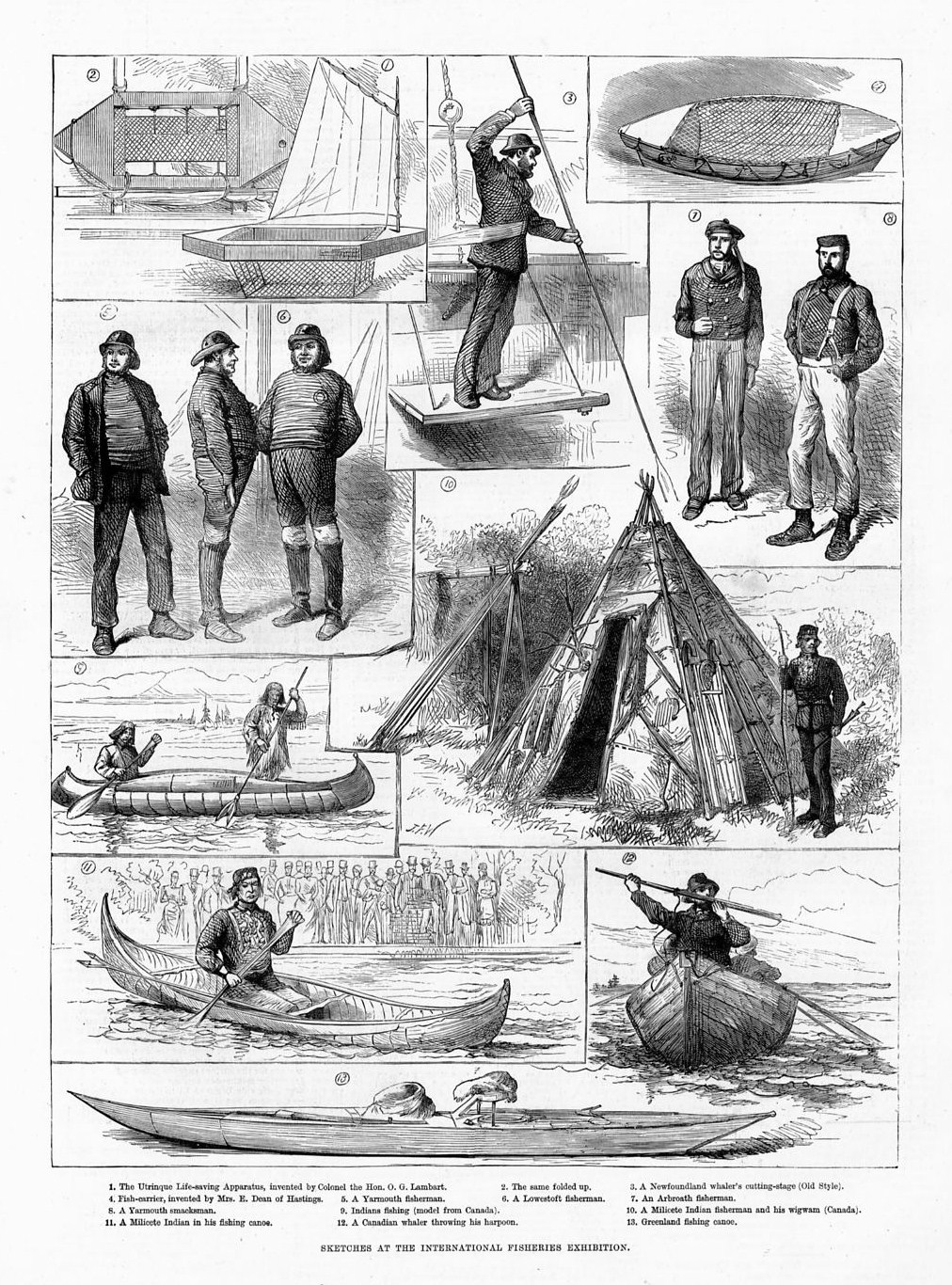
From this Ebay Link is an engraving of entitled "SKETCHES AT THE INTERNATIONAL FISHERIES EXHIBITION" published in The Illustrated London News June 2nd, 1883.


A closeup of sketch 9, "Indians fishing, (model from Canada)" showcases the classic Mi'kmaq humped canoe with a stern paddler and the bowman preparing to spear some Salmon)


9. Indians fishing, (model from Canada) 


Figure 11 has a different canoe and is labelled as a "Milicete Indian in his fishing canoe"

A Milicete Indian in his fishing canoe


The International Fisheries Exhibition of 1883 seems to have been quite a global affair. Another author, Frederick Whymper, documented some of the Canadian representatives in his book  Fisheries of the World : an Illustrated and Descriptive Record of the International Fisheries Exhibition, 1883. The sketch below is believed to be that of famed Maliseet Guide, Gabe Acquin.


"Indian in Birch Canoe, Fisheries Exhibition "
 Whymper, F. Fisheries of the World : an Illustrated and Descriptive Record of the International Fisheries Exhibition.  London : Cassell : Co.: Limited, 1883.
 Page 96


Sunday, October 30, 2016

Parkdale Maplewood Community Museum: Mi'kmaq style canoe & paddle

The Parkdale Maplewood Community Museum in Nova Scotia has a Mi'kmaq style bark canoe on display.


Accession number: 1946.Y.004 a
Date: 1862 - 1943
Measurements: 750.3 cm; 77 cm; 28 cm
Parkdale-Maplewood Community Museum
As per NovaMuse Educational Policy


According to the description, the canoe was made  by  John "Stephen" Rafuse. The exterior of the canoe has painted a deep shade of green, however the interior remains an unpainted. Root lashings aren't visible and there appears to be a green painted inwale so it is likely held together with nails.

Another shot from the Museum's exhibit page shows the same canoe with a fishing net and an accompanying green paddle...


Parkdale-Maplewood Community Museum


Parkdale-Maplewood Community Museum


Older Posts Home Page