Showing posts with label Antique Paddles. Show all posts

Saturday, April 4, 2026

Etched Penobscot Woodland Paddle

The recent Native American, Pre-Columbian, Tribal & Fine Art Auction by By Taos Company featured two vintage paddles:

Northeast Woodland Canoe Paddle
84 inches
Hand-carved wooden canoe paddle featuring an elongated blade form with remnants of original red and black pigment. The surface shows a warm, softened patina, and the tapered handle retains signs of use.
Provenance: John Magoone collection, ME


Penobscot Woodland Canoe Paddle
62 inches
Penobscot, finely carved with traditional Penobscot imagery on each side including a maple leaf, a Native chief in profile wearing a feathered headdress, a moose head with antlers, and leaf and floral motifs. The carvings are deeply incised and crisply rendered along the blade. Warm reddish-brown surface with an aged patina and subtle wear from handling. 
Ex. Jeff Cherry, NY & ME


Closeup of decorative etchings


Thursday, November 6, 2025

"EDH" 19th Century Penobscot Paddle

The upcoming Native American, Tribal, Ancient & Asian Art Auction from TAOS Auction Co (Santa Fe, New Mexico), features a 19th century Penobscot paddle with classic stepped grip pattern.

Penobscot Paddle
19th Century
64 ½ inches
Description: Penobscot, 19th century, hand-carved from a single piece of hardwood, with elongated curved blade and tapered handle terminating in a rounded grip. The initials “EDH” incised near the end. The surface exhibits a deep patina and smooth wear from age and use. 


Wednesday, September 17, 2025

c. 1916 Page Brand with original shipping label

The American Sporting Auction (Syracuse, NY) taking place on September 20, 2025 features a neat paddle with an interesting history that appears to have never been used.


American Sporting Auctions
Syracuse, NY, United States
September 20, 2005
Page Brand - New York Boat Oar Company
New York, NY c.1916
54.5" long
Provenance: Private Collection Midwest
Purchased for the Raquette Lake Boys Club by Master Gordon Schwartz and still retains all the original postage and customs documents


Ezekiel Page revolutionized oar making when he patented his groundbreaking oar turning machine and, in 1843, established the New York Boat & Oar Company at 69 West Street in New York City. His invention allowed oars to be produced with unprecedented efficiency, enabling the company to become one of the largest manufacturers of oars, sculls, and paddles of its time. 

The paddle itself features a crisp Page Brand mark and retains its original copper-ridged tip, a detail that ensured durability and performance.

Most interesting is that the paddle blade Page Brand stamps along with a Canadian customs sticker and matching tag documenting its shipment across the border.  Unfortunately a worn watermark smudged the year section on the customs tag but the paddle is assumed to not predate 1916 when the Raquette Lake  Boys Club was founded.  Addressed to Master Gordon Schwartz with his name appearing on both the sticker and the tag, this object offers a rare, almost whimsical glimpse into how fine paddles were casually shipped a century ago.


Thursday, September 4, 2025

1922 Canadian Canoe Co paddles

There is an early set of Canadian Canoe Company paddles  on display at the Rondeau Provincial Park visitor centre. They were given as a retirement gift to George Bartlett, superintendent of Algonquin Provincial Park, as a retirement gift in 1922, so these predate the merger of Canadian with the Chestnut & Peterborough companies and would be considered historically significant.

More info about the paddles can be read on this Ontario Parks blog post HERE


Saturday, February 1, 2025

Tom P acquires Chestnut Paddle

Some of the paddles in the private collection of Tom Penniston have been featured on the site. Tom was fortunate to recently acquire another spectacular pieces that was recently up for auction at Waddington's in December of 2024.

 Wolastoqiyik (Maliseet) Paddle
56.25 x 4.5 x 1 in — 142.9 x 11.4 x 2.5 cm
Image Courtesy of Waddington's Auctioneers and Appraisers, Toronto

While not attributed to any specific carver, the paddle's style is reflective of an older form of Maliseet/Wabanaki paddle with the tear-drop blade and pointed tip. A similar paddle shape is seen in an circa 1886 illustration featuring a similar flattened handle and large carved drip ring being paddled by tourists renting out bark canoes from this post here.


One side of the grip face is etched with the former owners name, "W. Chestnut". This would be William T. Chestnut (1867 - 1935) of Chestnut Canoe Co fame. Long before the establishment of the canoe company in 1904, William was an avid outdoorsman and hunter while working in the family business, R. Chestnut & Sons, Hardware Merchants. Surviving documentation and photos showcase his love for outdoor pursuits, including this circa 1887 photograph featuring men of a sporting club in Fredericton, New Brunswick paddling bark canoes near their summer camp, Camp Comfort. William Chestnut on the far left with the white sleeves. 

Provincial Archives of New Brunswick
Reference number: P5-175
TAYLOR, GEORGE: PHOTOGRAPHS
Description
Eight men in canoes from Camp Comfort Island. The artistic layout of this picture caused it to make quite a hit in 1887. Springhill in background.

The resolution and angle prevent seeing any details of his paddle, but it is not a stretch to think that in the 1880's these white patrons were commissioning birchbark canoes and accompanying paddles for their use from local Maliseet craftsmen. St. Mary's First Nation was located was directly across the river from Fredericton. Perhaps that it is the origin of William's which was customized with his name and an etching of nesting birds on the blade.


Wolastoqiyik (Maliseet) Paddle
56.25 x 4.5 x 1 in — 142.9 x 11.4 x 2.5 cm
Image Courtesy of Waddington's Auctioneers and Appraisers, Toronto


 Blade Closeup
Image Courtesy of Waddington's Auctioneers and Appraisers, Toronto


Friday, January 10, 2025

Wabanaki Paddles at the Maine Maritime Museum

Here are four paddles in the collections of the Maine Maritime Museum. They have been grouped together because of their Penobscot / Wabanaki influences.

Canoe Paddles
Catalog Numbers: 2007.024.1 - .4
Descriptions:
1 - Penobscot Indian paddle (70" long)
2 - paddle manufactured by E. M. White, in Penobscot style (69" long)
3 - Wabanaki paddle, probably Penobscot, with wide blade (74" long)
4 - Wabanaki paddle with scalloped edges, possibly Passamaquoddy or Maliseet (69" long) 


Friday, January 3, 2025

Tom Penniston's paddle acquisition: Rare decorated Mi'kmaw paddle

Some of the paddles in the private collection of Tom Penniston have been featured on the site. Tom was fortunate to recently acquire another spectacular pieces and has graciously allowed posting pics and details. This one has etched decoration on both sides of the handle but ink/dye drawings on one side of the blade. Dr. Roger J. Lewis, Curator of Mi’kmaq Cultural Heritage at the Nova Scotia Museum, has confirmed the paddle's origins as "definitely Mi’kmaq".

 
Decorated Mi’kmaq paddle


The grip also has a relatively unique style of roll grip that protrudes on one side but is flat on the other.
  
Etched decorations on grip


Ink artwork on blade


The non decorated side of the blade features an inscription with the first two lines reading:
"Made in gravel Pit yarmouth co ns"
" Mrs. L. Luxey made"

Gravel Pit Reserve was situated within Yarmouth county in southern Nova Scotia with the territory now forming part of Acadia First Nation. According to  Dr. Lewis, the Mrs. L. Luxey referred to in the inscription may be Mary "Lucy" Luxey (1855-1938) wife of Louis Luxey, chief of the Reserve. Unfortunately there is no date inscribed on the paddle  but if indeed it as was made by Mrs. Luxey as the inscription infers, it may one of the very few known examples carved by a female carver. 

Further proof of the Mi'kmaq  origin may be in the last line of the inscribed text. The first two words might be read as "al nu". Although the term Mi'kmaq is predominantly used by the tribal group today, another term used to refer to themselves in their own language was  "al nu" or sometimes phonetically written as "el nu". Much later in the mid-20th century the rules for writing were formalized and today the term is written as Lnu  or L' nu meaning "the people". Today, some of the reserves have the word Lnu in the name of the territory. As of yet, the rest of the phrase hasn't been translated. 


Monday, December 2, 2024

Rare Wolastoqiyik (Maliseet) paddles linked to Chestnut Canoe Company

Waddington's is currently hosting an online auction of Historic First Nations Art closing on December 5, 2024 at 2pm EST. Included in the collection are three stunning canoe paddles with an impressive provenance. Lot 14 is a pair of Wolastoqiyik (Maliseet) paddles featuring extensive double curved etchings on the blades. 

Wolastoqiyik (Maliseet) Paddles
60.5 x 5.75 x 1 in — 153.7 x 14.6 x 1.9 cm
Image Courtesy of Waddington's Auctioneers and Appraisers, Toronto


Although one of the paddles has some damage along the exterior edge, the blades are not cracked and intricate etching motifs are wonderfully executed by a skilful hand. Existing paddles with these elaborate double curved motifs are indeed very rare with just a few scattered in museum collections around the world. 
Lot 14  - Closeup of blades
Image Courtesy of Waddington's Auctioneers and Appraisers, Toronto


The elongated handles with graceful scalloped edges are marked with an inscription, "Ida" and are etched with the dates 1898 and 1899 on the reverse sides. 

Lot 14 - Scalloped grips with inscription
Image Courtesy of Waddington's Auctioneers and Appraisers, Toronto

The paddles belonged to William T. Chestnut and his wife Ida and hung in the Chestnut family cottage at Robertson's Point on Grande Lake, Jemseg NB. William was of course one of the brothers responsible for the establishment of the famed Chestnut Canoe Company and was an avid outdoorsman and canoeist well before the establishment of the canoe business. The paddles fit the profile of being carved by nearby Maliseet artisans from Kingsclear First Nation.


Lot 15 is another Wolastoqiyik (Maliseet) paddle of a different form and dimension. 

 Lot 15 - Wolastoqiyik (Maliseet) Paddle
56.25 x 4.5 x 1 in — 142.9 x 11.4 x 2.5 cm
Image Courtesy of Waddington's Auctioneers and Appraisers, Toronto


The blade features an etching of a nature scene with birds nesting surrounded by a leafy border.
 Lot 15 - Blade Closeup
Image Courtesy of Waddington's Auctioneers and Appraisers, Toronto

The slightly stretched grip bears another decorative etching and is inscribed "W. Chestnut". The paddle shows evidence of some in-water use including a slightly worn tip but is in remarkable condition.
 Lot 15 - Wolastoqiyik (Maliseet) Paddle
56.25 x 4.5 x 1 in — 142.9 x 11.4 x 2.5 cm
Image Courtesy of Waddington's Auctioneers and Appraisers, Toronto


These are absolutely fascinating specimens which rarely come up for auction. For more information and viewing of other available pieces, go to:


December 6th Update: Lot 14 Pair of paddles sold for $9500 CAD or approximately $6770 US (2 bids) with the Lot 15 William Chestnut paddle selling for $2200 CAD or approximately $1570 US (4 bids). Buyer's premium and sales tax in addition to the above.



Sunday, November 5, 2023

Circa 1860 "Pleasing the Spirits" paddle up for auction (again)

Bonham's  Auctions is featuring a circa 1860 paddle in their upcoming NATIVE AMERICAN & TRIBAL ART auction, set for 8 November 2023. LOT 84 features "A Northeastern Woodlands canoe paddle" which might be familiar to readers of this blog.


A Northeastern Woodlands canoe paddle
Malecite(?), c. 1860s
63 3/4 in.
Provenance: Private collection, New York. 
Collected in the St. John's River area of New Brunswick, Canada.

The uniquely carved stepped grip of this paddle features some floral incised decorative elements.


This paddle was originally illustrated in an exhibition catalog from 1982, Pleasing the Spirits. A Catalogue of a collection of American Indian Art by Douglas C. Ewing, Page 385, plate 474. It was up for auction back in 2009 where it fetched a realized price $2500 after being valued at $700. It seems to have been up for auction again in 2017. I made a replica from maple back in 2020 and it has become one of my favourites for relaxed solo paddling. Hopefully this treasure will go to a good home where it will be valued for the historic piece that it is.

Nov 10 2023 Update: Paddle sold for $3200 US (including buyer's premium)


Saturday, December 10, 2022

Swampy Cree Toy Paddle

Montreal's McCord-Stewart Museum collection includes a decorated model paddle with a painted blade. Although the maker in unknown, the paddle was collected from Moose Factory, James Bay

Swampy Cree Toy Paddle
Maker: Inconnu / Unknown
Date 1870-1878
Dimensions: 51.7 x 3.2 cm
Origin: Moose Factory, James Bay, Ontario, Canada
Numéro D'accession: M18577
Gift of Mrs. D. A. Murray


Saturday, December 3, 2022

Tomah Joseph Paddle

Another shot of the Abbe Museum's Indians & Rusticators exhibit which ran from 2012 - 2013 and featured a full-sized paddle carved by Passamaquoddy Elder, Tomah Joseph (1837 - 1914).


I've adjusted the contrast and flipped the image to get a fairly decent frontal outline of the paddle.


The paddle has been discussed before in this post here and currently resides at the Passamaquoddy Cultural Heritage Center & Museum in Indian Township, Maine.


Saturday, September 10, 2022

McCord Museum - Haudensaunee (Iroquois) Paddles

The McCord Museum has updated their online gallery to include a variety of Haudensaunee paddles. Two are from the Lac Tremblant region of Quebec with a decorated paddle blade fragment sourced to the Six Nations Reserve in Southwestern Ontario.


Haudenosaunee Canoe Paddle
1900-1920
Dimensions: 159 x 9.9 cm
Origin: Lac Tremblant, Quebec, Canada
Numéro D'accession: ACC2970.2
Gift of Dr. J. B. Porter


 Haudenosaunee Canoe Paddle
Date: 1900-1920
Dimensions: 159 x 9.9 cm
Origin: Lac Tremblant, Quebec, Canada
Numéro D'accession: ACC2970.1
Gift of Dr. J. B. Porter


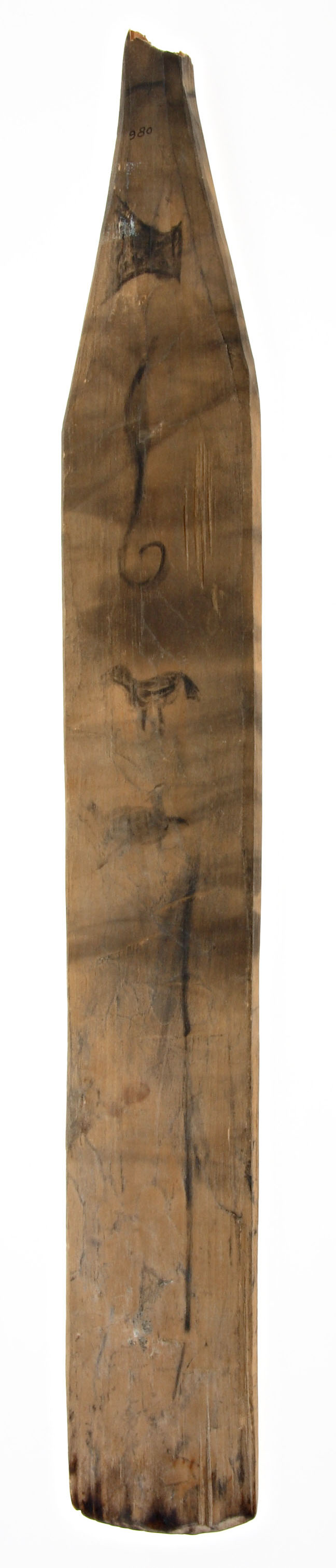
Iroquois Boat Paddle Fragment
1865-1900
Dimensions 8 x 55.8 x 2.3 cm
Origin: Six Nation Reserve area, Ontario, Canada
Numéro D'accession: M980
Gift of David Ross McCord


Saturday, February 12, 2022

Decorative carved antique

A curiously carved canoe paddle is currently featured on  LiveAuctioneers. The 58-1/2" paddle features an elaborate grip carved with a roll-top grip with scrolled and curved patterns on the palm rest. Also curious is a carved section in the middle of the shaft where deep notches and cross hatch pattern has been worked into the wood. 

Source Link


Thursday, April 8, 2021

Ciscos Gallery: Penobscot style paddle

Another paddle showcased by Cisco's Gallery advertised as a "Native Carved Canoe Paddle". It features the classic Penobscot stepped grip motif and is identified as carved from Birch.

Native Carved Canoe Paddle
Item Number: V69
SIZE: 60"L; Paddle 6"
Comments: Native carved canoe paddle with stylised notching and handle. Carved of birch, much patina from use. Paddle strong but very light.


Monday, March 8, 2021

Atikamekw paddles at the Université de Montreal

The Collection ethnographique of the Université de Montreal houses some Atikamekw artefacts which form the basis of an indigenous watercraft display.


The birchbark canoe canoe was made by Albert Biroté (1899-1977), an Atikamekw master craftsman from Wemotaci (Haute-Mauricie) in 1974. It was commissioned at the request of Norman Clermont, archaeologist from the anthropology department of the University of Montreal, as part of his investigation into the history of Wemotaci and the material culture of its inhabitants. 

Clermont's research was eventually published as a book entitled, La culture matérielle des indiens de Weymontachie. I was able to find a rare copy of this book housed at the Royal Ontario Museum's library. The publication contains a grainy image of the set of paddles also carved by Albert Biroté to accompany the canoe (see original post here).

La culture matérielle des indiens de Weymontachie 
Norman Clermont (‎1982) 

A second sketch appears in the book providing a closeup of the decorative element...


La culture matérielle des indiens de Weymontachie 
Norman Clermont (‎1982) 


New colour photos from the university reveal some more details of the paddle set, including closeup views of the deeply etched leaf patterns on the decorated handle. Curiously, this longer paddle of the two has been labelled as an "Aviron de Femme", a "Woman's paddle". Most other samples of gender specific paddles labelled by other museums and documentation (like Adney's description of Male / Female Cree paddles) had noted the shorter length of paddles typically utilised by women.


Aviron de femme
Item No: 75.5.3
Maple, Varnished
DIMENSIONS: L. 143.5 cm x l. 10.2 cm
DESCRIPTION: Oar in varnished maple. Handle decorated with flower motifs carved on both sides enhanced by light burning of the backwood.

The second paddle, plainly carved in birch features a much smaller bulb grip and is a few centimetres shorter.

Aviron d'homme
Item No. 75. 75.5.2
Birch 
DIMENSIONS: 134 cm x  13 cm


Older Posts Home Page