Showing posts with label Yellow Birch. Show all posts

Thursday, April 8, 2021

Ciscos Gallery: Penobscot style paddle

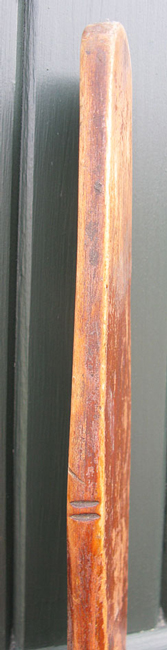
Another paddle showcased by Cisco's Gallery advertised as a "Native Carved Canoe Paddle". It features the classic Penobscot stepped grip motif and is identified as carved from Birch.

Native Carved Canoe Paddle
Item Number: V69
SIZE: 60"L; Paddle 6"
Comments: Native carved canoe paddle with stylised notching and handle. Carved of birch, much patina from use. Paddle strong but very light.


Friday, November 13, 2020

Late 19th Century Chippewa Paddle

Cisco's Gallery is featuring another unique antique paddle. Described as a "Chippewa canoe paddle with scroll carving at top", the paddle was apparently found along the Fox River, Wisconsin buried. Found along the Fox River, Wisconsin stuck in the shoreline mud. 

Chippewa Canoe Paddle
PERIOD: Late 19th Century
ORIGIN: Wisconsin
SIZE: 53"; Blade 5"

The lengthy flattened grip has a simple roll top and features a scroll pattern near the top, created by boring four holes and carving out curved spaces between them. The reverse spatulate blade shape culminates in broad tip that shows evidence of natural wear and chipping into a semi-rounded end. 


Grip and Blade closeups


The paddle features similar design elements to another piece (Lot 723) included in Cowan's 2004 American Indian Art Auction which was loosely identified as a "Great Lakes Maple Paddle".

Great Lakes Maple Paddle,
length = 66.5 inches
Provenance:Ex First People's Museum of the American Indian and Eskimo 


Friday, October 30, 2020

Rare Santee Sioux (Eastern Dakota) canoe paddle

 A relatively rare paddle find is now being showcased on Cisco's Gallery. The paddle is described as a late 19th Century design attributed to the Santee Sioux (Isáŋyathi or Eastern Dakota) from central Minnesota. 


Santee Sioux Canoe Paddle
Extra-long Santee Sioux canoe paddle from Minnesota. Carved of birch.
PERIOD: 19th Century
ORIGIN: Minnesota
SIZE: 78"L x 4 1/2"W

Though the bulk of the Siouan culture is associated with the American Great Plains, the Eastern Dakota were on the southwestern fringes of "canoe country" before being displaced by Ojibwe bands. As a comparison, see this earlier post which features sketches of Eastern Dakota peoples dated to 1851.


Tuesday, January 17, 2017

Birch York Sunbury Replica finally done after years of procrastinating

Back in 2012 I started on making a Yellow Birch replica of the circa 1878 Maliseet Paddle from the York Sunbury Museum (See posts here, here, and here). ...


c1878 York Sunbury Maliseet Paddle


Without a bandsaw in the city, a board of 6/4 Yellow Birch stock was hewn with an axe to get a rough outline. My experience with with Yellow Birch (Betula alleghaniensis) has been mixed as the wood is known to reverse grain frequently and is susceptible to much tearing of the wood fibres. Fortunately, this board was manageable and a rough blank was worked on .


The backyard workshop in early spring, 2012


My axe skills on kiln-dried wood are less than perfect so in the end, I struggled quite a bit with the symmetry, especially on the grip area. The area above the carved drip-ring ended up being more narrow than the original...


Not really happy with the results and frustrated with the carving, I let this paddle sit around. It eventually found use as a racoon deterrent for the creatures taking up residence on our upper deck.

In the meantime, the York Sunbury Museum has since changed its name to the Frederiction Regional Museum and better resolution pics were graciously supplied by a museum visitor. So this year the paddle was re-evaluated and the symmetry worked on some more. The blade was narrowed and the grip touched up to the best it was going to be. It was tested out with other designs on a quick daytrip and functions surprisingly well even though the original was commissioned as a tourist carving. The pointed tip makes the entry quite silent


Birch Maliseet on the left


Over the last few weeks I've been burning the blade and grip using a narrow writing nib at high heat to mimic the original, complex pattern. Here are the photos before oiling...


After a few coats of oil, the thirsty wood has taken on a much more golden colour and the paddle finally complete. That took a long while!

c1878 Maliseet Replica


Saturday, December 3, 2016

c1880 "G.W." Etched Maliseet Paddle

The good folks at The Cherry Gallery have once again posted another vintage paddle find.  I always look forward to a new month in order to check out their lovely current selections postings. This one is utilitarian birch paddle with a simple flattened grip. Photos and their detailed description below...

Maliseet Canoe Paddle
Circa 1880
6" w, 66.75” h

This birch canoe paddle has the characteristic details of Native paddles including a wide, flat handle, chamfering along the edges of the neck, a square-to-round profile transition at the throat of the shaft, a center ridge extending from the lower shaft to the upper blade, and a graceful beavertail-shaped blade. It also has two incised lines on each side of the handle which is a minimalist decoration seen on other Maliseet paddles. It retains its original dark, worn surface. The blade is chipped along one edge. There are incised initials “G.W.” on the back side of the handle.


Grip closeups


Blade closeup including chipped side

The Cherry Gallery's new find reminded me of another "user" paddle that was also authenticated to be a utilitarian Maliseet item. Back in 2011, I was contacted by someone wanting to post about a circa 1900 paddle for sale in their collection (read full original post here).


Circa 1900 Maliseet Paddle


Diamond shaped secondary grip


This paddle had been appraised in 2007 by Donald Ellis, one of Canada's renowned experts on native art. It had also been identified as a Maliseet paddle by the Curator of Cultural History and Art at the New Brunswick Museum in Saint John. At one time someone painted it white, then green which the curator mentioned likely preserved the piece. Not sure about the fate of this one, but hopefully both paddles have gone to a good home.


Wednesday, August 3, 2016

Circa 1890 Penobscot Paddle

The August 2016 current selections page of the CherryGallery.com features a wonderfully preserved birch paddle in a traditional Penobscot form...


Stepped-Handle Canoe Paddle
This birch paddle with a beaver tail blade and a long, multi-step handle is a traditional form that was made by Penobscot Indians. There is a slight twist in the shaft and a nick in the blade, but is in good condition for wall display.
Circa 1890
6.5" w, 64.25" h

For comparison purposes, check out this similar circa 1900 Penobscot paddle made from maple as well as all the other previous posts on the blog labelled "Penobscot".


Saturday, September 1, 2012

c1878 York Sunbury Maliseet Replica: Part 2

I've been working on a replica of the c1878 York Sunbury Maliseet since the winter. Back in May, I posted about the progress and more or less thought the paddle was done for the decoration phase. But after letting it sit for a few months, it still felt too bulky and lacked some flex. So it was brought out again and worked down a bit...


The backyard workshop in winter


Reworking on the shaving horse 

The original oval-shaped shaft felt too thick so it was worked back into a round shape with a crooked knife. Didn't realize I acquired so much grey hair this year...


Given that this blank was hacked out with an axe, the symmetry isn't perfect. Kind of messed up the based of the grip above the carved drip-ring and it ended up being more narrow than the original... 


My yellow birch version & the c1878 original 

For now, the blank looks quite pale but after a bit of aging and oiling is should darken nicely. A few days after this pic was taken, my wife was spooked by a family of 6 raccoons that had decided to get comfortable on our deck in the middle of the day. A PBS documentary recently declared Toronto "The Raccoon Capital of the World" and the huge population of fuzzy bandits are quite the nuisance to most residents day and night. Anyway, loud noises did nothing and they even stood their ground after an aggressive spraying with water. I've come across black bears that are more timid than these little devils! Ended up using grabbing this paddle and gently poked the mama to make her realize that our little deck wasn't a good place to visit. She scurried off and her little ones followed.  

It reminded me of a drawing by Tappan Adney which appeared in an article entitled, "Beaver Ways" in Outing - Vol XLI - March 1903. Apart from propulsion, paddles can be used to keep the wildlife at bay (check out the hilarious caption on the lower left!)


Thursday, May 17, 2012

c1878 York Sunbury Maliseet Replica: Part 1

Another paddle is in the works. For a few months now, I've been intending to replicate the c1878 Maliseet Paddle from the York Sunbury Museum...see posts here, here, and here.


c1878 York Sunbury Maliseet Paddle


Unfortunately (or fortunately depending on how you look at it), I made a carving error with yellow birch stock that was originally sourced for this paddle. Instead, I ended up with a custom design influenced by the Maliseet / Passamaquoddy paddle at the McCord Museum.

Luckily, another board of Yellow Birch was on hand and I ended up chopping out the rough outline with the axe. Given the pressure of using up my last yellow birch board, I didn't end up taking pics of the chopping process (most readers have seen enough of those pics I'm sure.) Unlike last time, this board was much easier to work with an axe,  spokeshave and crooked knife without tear out and catastrophic results. After working out the general shape without wrecking the blank and cleaning up the paddle with the spokeshave, the following pic just after Toronto received a paltry speckling of wet snow that was typical of this year's "winter" in the city.


The backyard workshop


Over the next few weeks, the paddle was worked on whenever time and weather permitted. The board stock for this one was originally 6/4 which meant that the paddle started off a little thicker than the usual 5/4 boards I source out. A decision was made to leave the shaft oval shaped rather than round like is usually done with my other creations. Furthermore, the last few paddles have been  thinned and carved to be very flexible as users. Since the original highly-ornamented paddle was likely for ceremonial purposes and not for daily usage, it was  decided to leave  it a little thicker than usual and maintain  a bit more stiffness than what I usually prefer in my user paddles.

Springtime in the backyard workshop

Here's a shot of the wetted paddle. A little bit more scraping to remove the raised grain and she'll be set for the beginning of the decoration phase.


Luc Poitras, a fellow paddle carver, emailed  a question about the woodburning equipment I use so in the future update, I'll be sure to include details and pics of the equipment and technique.

This weekend is a holiday here in Canada and the marks the unofficial start to the canoeing season. We're heading up north as well where my canoes will finally hit the water after a winter of hibernation storage. Hoping to test this one out and get some pics of my last few paddles as well.


Sept 1, 2012 UPDATE: Part 2 has been posted online


Sunday, January 15, 2012

Yellow Birch "Mistake" Paddle

Everybody makes mistakes, right? I've often posted about some of my learning experiences (i.e. mistakes) in this hobby, some of which end in utter disaster...like my attempt a bushcraft carved cedar paddle a while back. Here's another mistake in paddle carving, but one I think I've been able to salvage.

The backstory: Next up on my "to do" list of paddle replicas was the c1878 Maliseet Paddle from the York Sunbury Museum...see posts here, here, and here.


1878 Maliseet Paddle

This time I wanted to be as accurate as possible and didn't modify the blade or grip design, just the overall length. For the pyrography decoration to stand out though, I decided to replicate the paddle in Yellow Birch...a nice carving wood for paddles that burns very evenly as well. A suitable plank of Yellow Birch as obtained and the design all sketched out. But being impatient, I couldn't wait to head up north to the cottage where I have a bandsaw to cut out the pattern. Instead, it was back to old fashioned method of chopping out the paddle with axe and hand tools...it worked out reasonably well in Ash Malecite a few weeks before.

Big mistake. This board of yellow birch proved to be quite a challenge. I've never chopped yellow birch with an axe before and even though the grain pattern looked quite straight, it somehow kept "reversing" so that every few axe strokes, there would be a tremendous amount of tear out. Flipping the paddle over and over and and trying to chop out the paddle in this manner without causing tons of damage proved to be quite difficult and frustrating.

Along the way, I ended up tearing off a huge chunk of wood from the of shaft and the edges of the blade where horribly torn into jagged splinters... basically the original design was ruined! I was angry at myself for spending a day making nothing more than expensive kindling and never took any pictures as a result. Eventually, things cooled down a bit (thank you Elijah Craig Bourbon!) and I figured out a way the paddle could be still saved.

This meant narrowing the blade by nearly 1 inch and reducing its length by cutting off a new, flatter tip 2 inches higher. This would've made the paddle much shorter than I like, so basically the grip was extended to compensate for the blade reduction. I usually draw on on the design about 2-3 inches from the end of the board since the ends tend to have minor splits from the drying process and so there was a little wiggle room. The grip was brought up to the end of the board. To my eye...it makes the grip area look ridiculously long, but the paddle balances out surprisingly well. In order to smooth out all the mini tears and rough patches on the blade, I ended up power sanding with a ROS for a long time (sorry neighbours!) but it's a smooth as it is going to get. Here's the end result when I finally decided to take some pics...


Here are some closeups of the damaged shaft just below the carved drip ornamentation at the base of the grip. To repair, I basically mixed some woodglue with the abundant about of sawdust from the sanding process to make a putty. Filled in the gouges, replaced the broken splinter of wood, wrapped in wax paper and clamped it loosely into place overnight. After some more vigorous sanding, it's not looking that bad.


Shaft tear-out; repair job

The new blade design (4" wide by 26.5" long) isn't even close to the original Maliseet pointed tip of the orginal paddle. So I'm going to forget about making a replica with that pattern and try another attempt with some remaining lumber stock. I'll have to think about what to do for decoration on this one...


New blade design; Very long grip with drip ring carvings


April 15, 2012 Update: Paddle has been completed and decorated. Click HERE for that post



Thursday, June 10, 2010

Reshaped Birch Cree Paddle - Part 1

Just around the corner from home, I spotted an amateur "Antiques for Sale" sign pointing to an industrial warehouse. Intrigued, I went inside and found a huge haphazard collection of stuff that had seen better days. I was on my way out when I saw the shape of a paddle behind a pile of rusty tools. It turned out to be a half-completed, 57" paddle blank made from what appears to be yellow or white birch.


The partially complete Birch blank

The wood stock seems to have been 1" thick as this is the maximum thickness of the shaft. Not ideal for a heavy use paddle, but still workable for light use. At least the grain in the shaft is well contained and runs perfectly parallel down its length so the original builder was either lucky or knew exactly what was needed for paddlemaking. The bulk of the blade had been power planed down to about 1/2" with some noticeable areas of tear out but these should be easy to clean up with some spokeshave work. A small, crudely shaped pear grip had been rasped out. Basically the hard work had been done and now only final shaping needed to be completed. In pencil along the shaft was the name "Skyler". It seems someone started this project but then abandoned it. The paddle was mine for $5 and I immediately began visualizing reworking it.


Small Pear Grip

My first observation was how huge the blade area was relative to the length and this caused the paddle to be extremely blade heavy...not ideal. The 5.5" wide blade had a beautifully rounded tip and I wanted to preserve this feature. But to make the paddle more balanced, the blade area had to be reduced. After being please with the Attikamekw design as a favoured solo blade, I wanted to try another close style to this slender shape. In particular, I've been eager to try some of the Cree Style paddles I've posted on before.


Cree Paddles - Canadian Museum of Civilization

In the end I chose the sweeping, recurved blade design of the middle paddle. After marking out some of the basic points on the blank, I used some clamps and a flexible metal ruler to draw out the curves. Here is the result...


New blade shape marked out for cutting

The Mrs. did some planting and cleaned up the balcony last weekend. I can tell she doesn't appreciate the wood dust and shavings in her flowerpots, so in order to minimize any domestic disturbance, I headed to the nearby park with the paddle, a saw, and my two crooked knives. Rather than saw out the entire paddle shape, I thought I take a shortcut and make some perpendicular cuts, chip out the rough shape, and clean it up with the crooked knives. While I had brought both knives to the park, the recently completed Orien Knife outperformed by own homemade version, mostly because of the steeper bevel being better suited to the kiln dried hardwood, birch stock. Here's where the paddle stands now...obviously not an exact replica but I had to work with the limitations of the existing dimensions.


Chipping out the outline; Cleaned up with the crooked knife

The sharper angles will be eventually worked down. But it's a funky shape and I'm curious to see how it'll perform.

SEPT 21, 2010 UPDATE: Paddle is now complete and decorated. See post HERE


Older Posts Home Page