Showing posts with label Penobscot. Show all posts

Saturday, April 4, 2026

Etched Penobscot Woodland Paddle

The recent Native American, Pre-Columbian, Tribal & Fine Art Auction by By Taos Company featured two vintage paddles:

Northeast Woodland Canoe Paddle
84 inches
Hand-carved wooden canoe paddle featuring an elongated blade form with remnants of original red and black pigment. The surface shows a warm, softened patina, and the tapered handle retains signs of use.
Provenance: John Magoone collection, ME


Penobscot Woodland Canoe Paddle
62 inches
Penobscot, finely carved with traditional Penobscot imagery on each side including a maple leaf, a Native chief in profile wearing a feathered headdress, a moose head with antlers, and leaf and floral motifs. The carvings are deeply incised and crisply rendered along the blade. Warm reddish-brown surface with an aged patina and subtle wear from handling. 
Ex. Jeff Cherry, NY & ME


Closeup of decorative etchings


Thursday, November 6, 2025

"EDH" 19th Century Penobscot Paddle

The upcoming Native American, Tribal, Ancient & Asian Art Auction from TAOS Auction Co (Santa Fe, New Mexico), features a 19th century Penobscot paddle with classic stepped grip pattern.

Penobscot Paddle
19th Century
64 ½ inches
Description: Penobscot, 19th century, hand-carved from a single piece of hardwood, with elongated curved blade and tapered handle terminating in a rounded grip. The initials “EDH” incised near the end. The surface exhibits a deep patina and smooth wear from age and use. 


Friday, January 10, 2025

Wabanaki Paddles at the Maine Maritime Museum

Here are four paddles in the collections of the Maine Maritime Museum. They have been grouped together because of their Penobscot / Wabanaki influences.

Canoe Paddles
Catalog Numbers: 2007.024.1 - .4
Descriptions:
1 - Penobscot Indian paddle (70" long)
2 - paddle manufactured by E. M. White, in Penobscot style (69" long)
3 - Wabanaki paddle, probably Penobscot, with wide blade (74" long)
4 - Wabanaki paddle with scalloped edges, possibly Passamaquoddy or Maliseet (69" long) 


Monday, October 9, 2023

Mariner's Catalog (1973) - Henri Vaillancourt Paddles

Came across a 50 year old photo published in the 1973 publication,  The Mariner's catalog, available for 1 hour borrowing on Archive.org. It accompanies a brief write-up of the Malecite style paddles carved by Henri Vaillancourt. The photo is B&W is quite dark and grainy but the beautifully sculpted blades with sharp spines are visible. 


Tuesday, July 25, 2023

Alexandra Conover Bennet Demonstrates the North Woods Paddle Stroke

 A recent video clip of Alexandra Conover-Bennet showcasing a Penobscot-style paddle, Wabanaki birchbark canoe and the "Northwoods Style Stroke" is now on YouTube. It originally appeared on the WoodenBoat channel, Season 3, Episode 3 of their "Mastering Skills" Series.


Sunday, April 30, 2023

Historic Paddle Image - Wabanaki Bark Canoe - Hudson Museum

The University of Maine Hudson Museum photograph collection features a great shot of an overturned Wabanaki canoe and two paddles. An exact date is unavailable; the image is loosely dated to the early 20th Century but the individuals in the pose have been identified.


Sepia tone photographic print of (left to right) Sylvia, Stephen, and Francis Stanislaus standing behind a birchbark canoe.
Catalog Number: HM9303.1


Monday, July 18, 2022

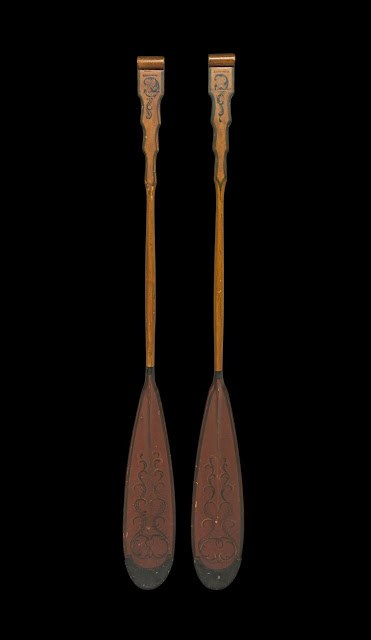
Oscar Farrington Canoe Paddles, circa 1864

In the collections of the The Maine State Museum are a set of decorative paddles with some interesting decorative and carved elements. 

Catalog Number: 75.10.1
Object Name: Paddle, Canoe
Artist-Maker: Unknown
Place Made: MAINE
Date Made: Circa 1875
Media Materials: Wood, Oil paint
Measurements: 63" x 6 1/2" x 1 1/8"


The painted blades have tiny shoulders and a distinct spine. The tips have been painted black and the blade face features some double curve motifs. The handle consists of a stepped grip similarly scene in traditional Penobscot paddles, but this one features a cylindrical roll grip on top. More painted scroll patterns appear on the flattened grip face. Stamped twice onto the grip face is the name "O. Farrington" along with a date of "1864".

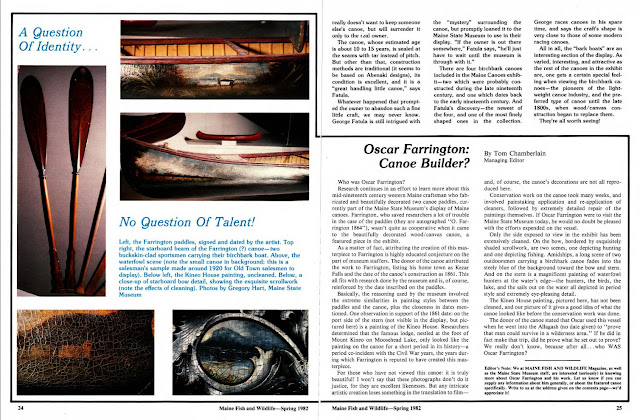
A digital copy of Maine Fish and Wildlife Magazine (Spring 1982) features an article entitled, "Oscar Farrington. Canoe Builder?" on pages 24-25. The article discusses the likelihood that a decorated cedar canvas canoe in the collection was also made by the same hands.


Saturday, January 29, 2022

Circa 1900 Penobscot Maple paddle and Historic Photograph

The January 2022 'New Finds' page at the CherryGallery.com features a large, circa 1900 Penobscot paddle:

Penobscot Canoe Paddle
Circa 1900
Maple
8” w, 74.5” h


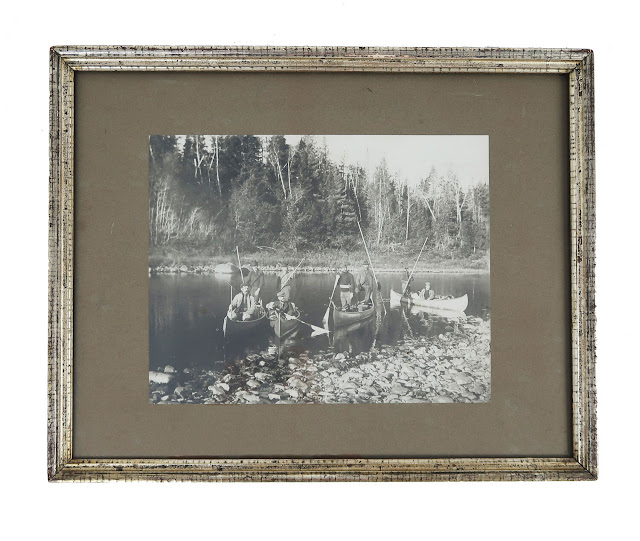
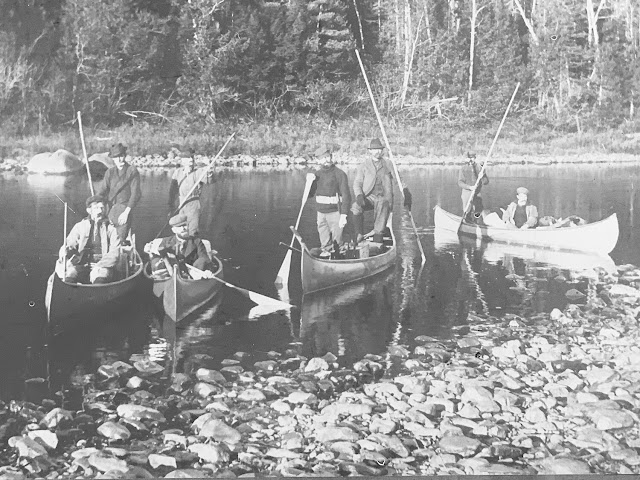
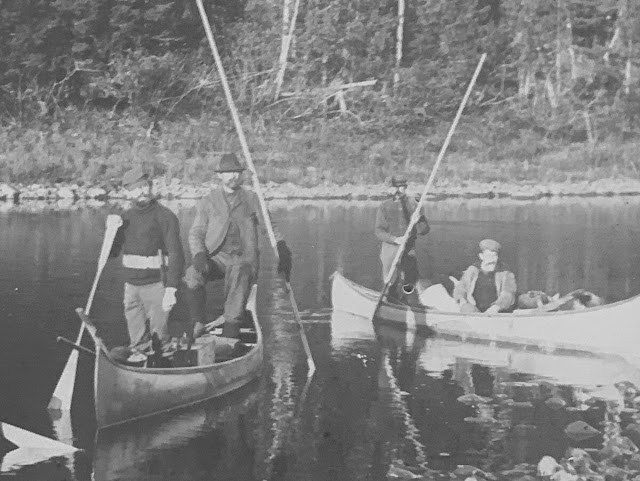
Also featured is a photograph dated to the same era of some Maine Guides posing with their cedar canvas canoes:

The write-up explains:
This is a rare and fabulous large photo of four wood and canvas canoes pulled up along the gravel beach of a river. Four guides stand in the sterns holding long poles for traveling upstream, and each canoe has a man in the bow. The canoes are packed with gear indicating that the hired guides are taking their “sports” on a multi-day fishing trip.


Thursday, April 8, 2021

Ciscos Gallery: Penobscot style paddle

Another paddle showcased by Cisco's Gallery advertised as a "Native Carved Canoe Paddle". It features the classic Penobscot stepped grip motif and is identified as carved from Birch.

Native Carved Canoe Paddle
Item Number: V69
SIZE: 60"L; Paddle 6"
Comments: Native carved canoe paddle with stylised notching and handle. Carved of birch, much patina from use. Paddle strong but very light.


Wednesday, March 10, 2021

Historic Paddle Photo: Guide Andrew Nicholas Penobscot / Maliseet Paddle

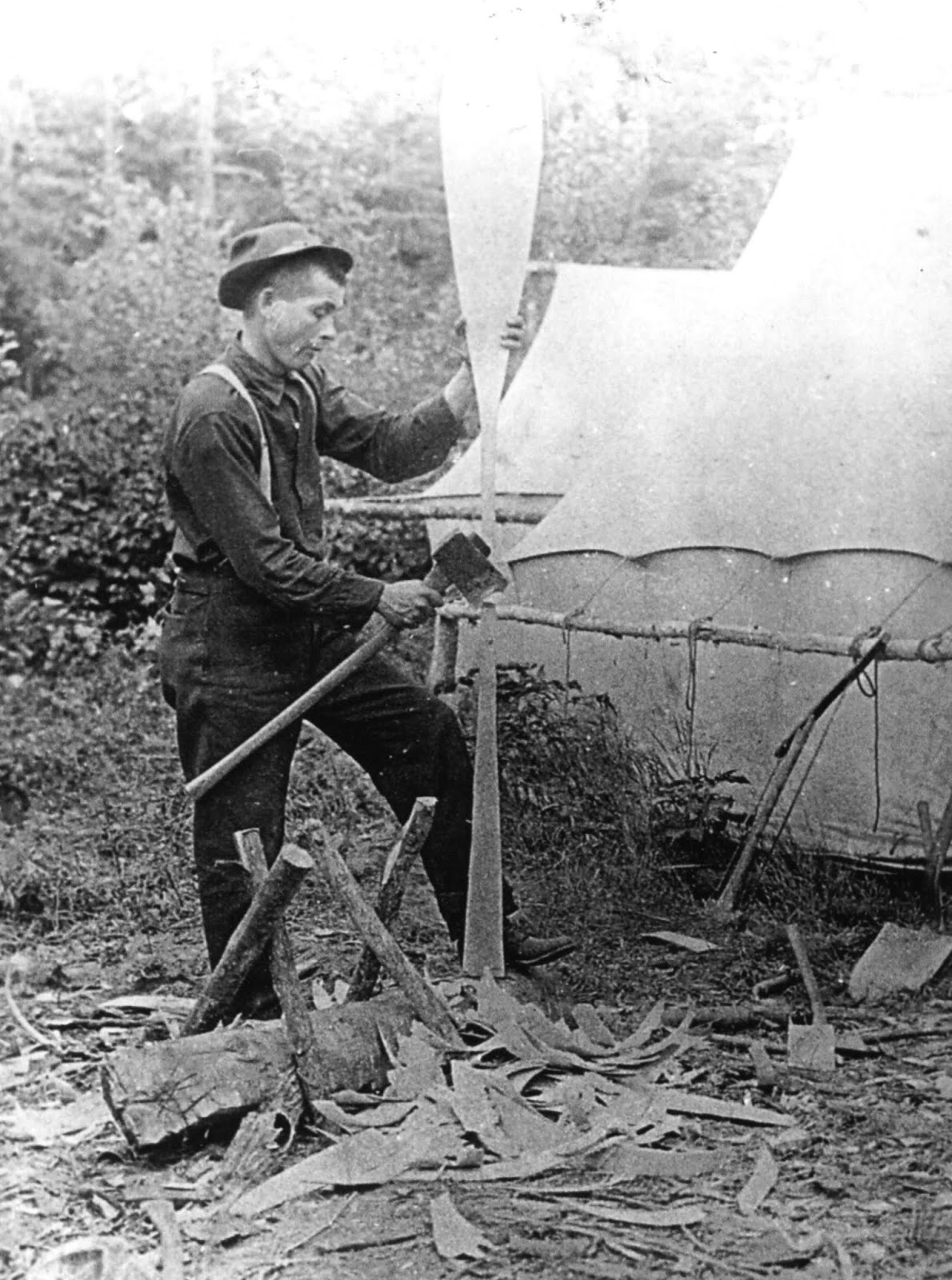
Here's a beautiful historic pic of native guide Andrew Nicholas (November 1, 1869 - July 10, 1935) in the act of carving a paddle with bushtools...


A brief bio online mentions Nicholas was born at Chesuncook, ME and worked  primarily as a sporting guide. Through living in Penobscot territory his heritage was Maliseet from the the L'isle Verte region of Quebec.


Friday, January 29, 2021

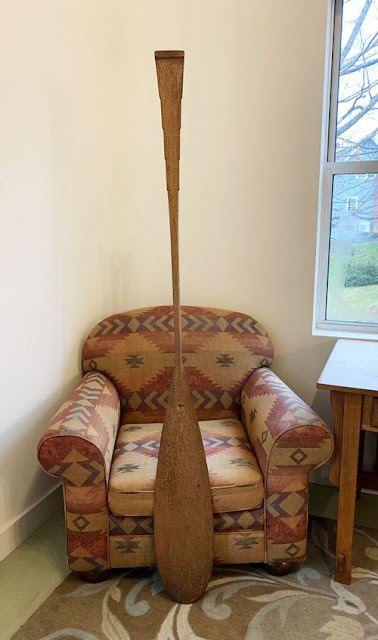
Full-Sized Hudson Museum c1900 Penobscot Replica

 Many years ago, I came across a beautifully sculpted paddle being sold at auction. It was cited as a Penobscot design but was somewhat unique as it was carved from softwood rather than typical Wabanaki paddles. A long one at 77", the paddle showed signs of usage but also featured a delicately shaped grip complete with floral and geometric etchings.


Rather than ending up in an obscure private collection, the paddle was purchased by the Hudson Museum at the University of Maine. Additional photos taken by the museum of the opposite side revealed the grip etchings had remnants of red paint matching the blade.


The museum has now added the paddle to their Wabanaki  gallery as seen in this YouTube footage and it looks to be right at home in front of a 19 foot Penobscot bark canoe.


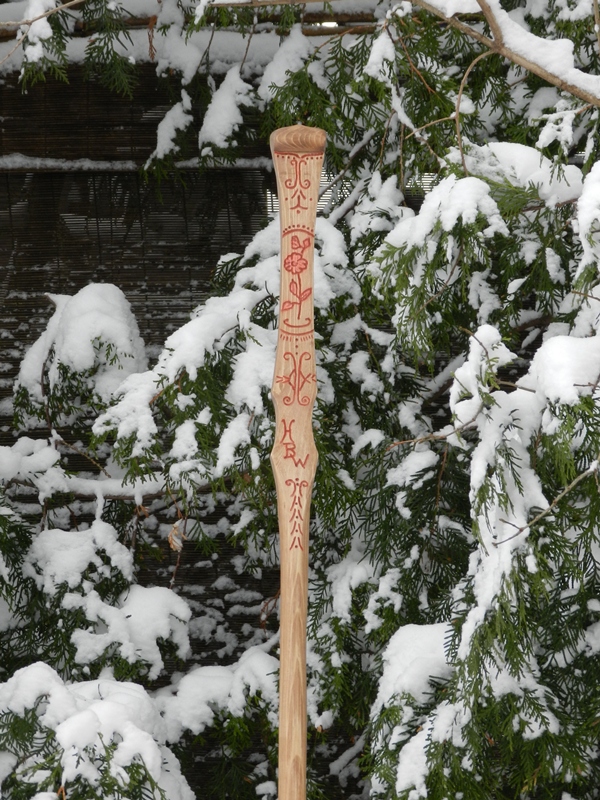
Back in 2012, I made a reduced-scaled, shorter version of this from a piece of Sassafras and burned the decoration. I've used it on occasion, but decided to make a full sized, 77" replica from a clear section of of a 2 by 10 spruce board. I started the initial shaping with an axe and have been steadily working on it on thinning out the blade with a crooked knife.

Given all the late season distraction work done on the Trapper Canoe restoration, work on this paddle was a little slow. Eventually it was shaped down and scraped smooth ready for the decoration just as the weather turned


The etching on the handle was replicated with a rotary tool and the cavities filled with opaque, red milk paint. The blade was also painted while the bright spruce was stained with a gel stain in order to mimic the weathered patina of the original. On Christmas Day, we were gifted with 15 cm of fresh snow that made taking photos even more picturesque. 


At 77" with a nearly 3 foot long blade this is the longest paddle I've attempted. Should be great for some stand-up paddling once paddling season begins again in the spring.



Wednesday, November 25, 2020

Pair of Side Chip Carved Penobscot Paddles

A gorgeous pair of Penobscot Paddles is up for sale on 1stDibs.com. Dated to the 2nd half of the 19th Century, the paddles were varnished at one point in their lifetime and are now feature a heavily crackled surface. The seller cannot identify the wood species as it has darkened considerably due to age.


Maine
Length: 69 inches
Blade width: 6 inches
Date: Second half of the 19th century
Materials: Long grain hard wood.
Condition: Excellent. The brown varnish surface is deeply patinated with a beautifully crackled surface.
Comments: Both paddles are finely chip carved on both sides of the paddle handles and uniquely chip carved along the handle edges of each. The chip carved designs are classic, ancient, Algonquin symbols.
Source Link


The grip areas feature subtle carving symbols along the grip face, with one featuring the sun circular sun and and a crescent moon on opposing sides.


 Most unique are the geometric chip carvings along the thin edges of the elongated grips. Most certainly these were carved by the hands of a master paddle maker.


Thursday, November 19, 2020

Historic Paddle Photo: Maine Guide George Spears standing in bark canoe

Found some more historic photos on Archive.org taken by an amateur photographer, Ervin S. Hubbard sometime between 1893 - 1902. This scene captures two bark canoes and guide, George Spears standing with a paddle. Though undated accompanying text states it was taken on Tomah Stream in Maine

Tomah Stream, Maine, Undated
by Ervin S. Hubbard
Ervin S. Hubbard Glass Plate Negative Collection
Digitizing sponsor George Washington University Libraries


Tuesday, September 29, 2020

93 inch Maine Paddle

An Ebay seller recently found a huge paddle at an Maine Estate barn. The paddle is a whopping 93 1/2" with a 3 foot blade. 

93" Maine Paddle


The blade is stamped on both sides with a faded incised mark that could either read as "O. B. CO" but the B could be a P or other rounded letter.


The paddle is consistent with long paddles used for ocean going canoes used by various groups of Wabanaki peoples, most notably the Penobscot or Passamaquoddy peoples. Other examples previously featured on the site are the 77" decorative Penobscot, an 84" mustard yellow painted paddle,  a 90" painted paddle and a similar 96" ochre painted design

Such long paddles were useful for stand up paddling in ocean canoes and were relatively common place by these coastal peoples. 

Margarette Francis
Kingsclear, University of New Brunswick Archives.

Later these huge paddles were adopted by lumbermen using wooden batteaux on spring log drives. Perhaps the O.B. CO. marking refer to an obscure logging company.


Wednesday, August 5, 2020

Historic Paddle Image: 1905 Northeast Carry Penobscot River

Another historic paddle image found on Worthpoint.com. This one published by G.H. Graves (from a William H. Rau negative) featuring some sports and guides at the Northeast Carry on the Penobscot River. Another party of canoeists is seen faintly off on the distance. Clear shots of the large bladed paddles and canvas canoes are visible.


If the photo looks familiar, it is because it appeared in various publications. I posted this very same image back in 2017 (link here). It appeared in the 1907 publication, With Gun and Guide, by Thomas Martindale.


Monday, July 27, 2020

PEM: Model Canoe and paddles (1878)

Another model canoe in the collection of the Peabody Essex Museum is attributed to  Jo Polis, the famed Penobscot who guided Thoreau in 1857 journey in the Maine interior. The model is dated to 1878 and features decorative winter bark etchings and two paddles consistent with the Penobscot carving tradition.

Penobscot Artist
Model canoe, 1878
Wood, birchbark, plant fiber
Maine, Northeastern United States
L: 38 1/2 in, W: 7 5/8 in, D: 6 1/2 in (L: 97.8 cm, W: 19.4 cm, D: 16.5 cm)
Gift of Mr. Edward S. Moseley, 1979
E28528
Work attributed to Joe Polis (also known as Jo Polis)

This birchbark canoe was made for sale in Old Town, Maine in August, 1878, during the height of the summer season, when tourists bought souvenirs such as this en masse. The exterior of the canoe is decorated with lovely scrolling curve and floral motifs, while the bottom depicts a winter scene with a hunter, a moose, and a clumsy snowshoer.
 INSCRIPTION
The inscription on the bottom reads, "Akist 24, 1878, O. T. Me Moose". This can be understood to mean "August 24, 1878, Old Town, Maine, Moose."
 DESCRIPTION
This is a birch bark canoe model with two paddles and one fishing spear. There are five thwarts in the canoe, the center one is decoratively carved. The outer surface of the canoe is ornamented with double curve and floral motif designs etched on the bark. There is an etched narrative scene on the bottom of the canoe depicting two men, wearing snow shoes, hunting a moose. One of the men has comedically fallen over. The artist has etched his name in the bottom with the narrative scene. Likely made by Jo Polis, according to scholar Joan Lester.


Thursday, June 4, 2020

Historic Paddle Image: Northeast Carry Camp

Here's another image (originally a stereoview) from A. L. Hinds of Benton, Maine. It is a Penobscot camp labelled as being near the North East Carry in Maine's famed Moosehead Lake region.

Source Links: Found originally on Worthpoint.com but also listed on Ruby Lane

White tourists are posing with members of the camp. Full sized paddles and large rolls of birchbark, likely for canoe construction, appear resting against the shelter on the far left. In the center frame, a guide holds up his paddle in and inverted manner providing a fantastic frontal view of the shape.

A further identical copy with zoomable features is found at the UMaine's Digital Commons library. The details in the description mention the image is from a set entitled  "Scenery in Northern Maine, Moosehead Lake series". This is image number 10, captioned "Indian Camp, (North East Carry)."


Tuesday, March 3, 2020

Update on a circa 1900 Penobscot Paddle with Chip-carved Motif

An update of the circa 1900 Penobscot paddle with the grey painted blade and chip-carved sun motif discussed earlier here. It seems the paddle was sold at auction back in September of 2019. Efforts are underway to contact the new owner in the hopes of getting more dimensional info and close up photos.


Penobscot Indian Paddle With Carved Sun Motif.
Step carved handle, gray polychrome painted paddle. 
Overall length 78 inches.
Casco Bay Auctions
Lot 101: September 8, 2019
Freeport, ME, USA


Sunday, January 5, 2020

Large Penobscot paddle with sun carving

From a dated listing on Worthpoint.com are some photos of an antique Penobscot paddle estimated to be circa 1900. The grain pattern is consistent with Ash. It is a very large design at 78" long with an 8" wide beavertail blade painted in a faded grayish paint and along with a classic Penobscot 5-stepped grip handle. Apparently found in an estate in Northern New Hampshire along the Androscroggin River.

Penobscot Paddle
78 inches long x 8" wide
Gray Paint on Blade

Grip Closeup

The upper grip face features a nail hole, likely used to suspend the paddle on the wall as decoration or as a method of hanging the freshly carved paddle to dry and eliminate warping of the green wood. The upper palm rest also features a circular chip-carved, sun motif .


Sunday, December 22, 2019

Mid-19th century Penobscot paddle (Poplar)

Archived on Worthpoint.com is an interesting paddle originally from Cowan's  American Indian and Western Art: Live Salesroom Auction (4/8/2017). What makes this one different from other 19th century Penobscot designs is the claim it is made of Poplar (Liriodendron tulipifera). While utilised today to make inexpensive paddles and oars, it was not a common wood in the Northeastern paddle making tradition as evident by lack of documentation and surviving paddles made from this wood. Poplar is also a relatively weak wood compared to more commonly used ash and maple, yet this huge 75" paddle has a hefty 7.5" wide blade. To survive the stain of use, the shaft would benefit from being much thicker.

Penobscot Wood Paddle (mid-19th century)
poplar; length 75 in.
The beveled, triangular grip gracefully transitions to a round shaft and teardrop-shaped blade; surface with warm patina 

Grip Closeup


Older Posts Home Page