Showing posts with label Maliseet. Show all posts

Friday, January 10, 2025

Wabanaki Paddles at the Maine Maritime Museum

Here are four paddles in the collections of the Maine Maritime Museum. They have been grouped together because of their Penobscot / Wabanaki influences.

Canoe Paddles
Catalog Numbers: 2007.024.1 - .4
Descriptions:
1 - Penobscot Indian paddle (70" long)
2 - paddle manufactured by E. M. White, in Penobscot style (69" long)
3 - Wabanaki paddle, probably Penobscot, with wide blade (74" long)
4 - Wabanaki paddle with scalloped edges, possibly Passamaquoddy or Maliseet (69" long) 


Monday, December 2, 2024

Rare Wolastoqiyik (Maliseet) paddles linked to Chestnut Canoe Company

Waddington's is currently hosting an online auction of Historic First Nations Art closing on December 5, 2024 at 2pm EST. Included in the collection are three stunning canoe paddles with an impressive provenance. Lot 14 is a pair of Wolastoqiyik (Maliseet) paddles featuring extensive double curved etchings on the blades. 

Wolastoqiyik (Maliseet) Paddles
60.5 x 5.75 x 1 in — 153.7 x 14.6 x 1.9 cm
Image Courtesy of Waddington's Auctioneers and Appraisers, Toronto


Although one of the paddles has some damage along the exterior edge, the blades are not cracked and intricate etching motifs are wonderfully executed by a skilful hand. Existing paddles with these elaborate double curved motifs are indeed very rare with just a few scattered in museum collections around the world. 
Lot 14  - Closeup of blades
Image Courtesy of Waddington's Auctioneers and Appraisers, Toronto


The elongated handles with graceful scalloped edges are marked with an inscription, "Ida" and are etched with the dates 1898 and 1899 on the reverse sides. 

Lot 14 - Scalloped grips with inscription
Image Courtesy of Waddington's Auctioneers and Appraisers, Toronto

The paddles belonged to William T. Chestnut and his wife Ida and hung in the Chestnut family cottage at Robertson's Point on Grande Lake, Jemseg NB. William was of course one of the brothers responsible for the establishment of the famed Chestnut Canoe Company and was an avid outdoorsman and canoeist well before the establishment of the canoe business. The paddles fit the profile of being carved by nearby Maliseet artisans from Kingsclear First Nation.


Lot 15 is another Wolastoqiyik (Maliseet) paddle of a different form and dimension. 

 Lot 15 - Wolastoqiyik (Maliseet) Paddle
56.25 x 4.5 x 1 in — 142.9 x 11.4 x 2.5 cm
Image Courtesy of Waddington's Auctioneers and Appraisers, Toronto


The blade features an etching of a nature scene with birds nesting surrounded by a leafy border.
 Lot 15 - Blade Closeup
Image Courtesy of Waddington's Auctioneers and Appraisers, Toronto

The slightly stretched grip bears another decorative etching and is inscribed "W. Chestnut". The paddle shows evidence of some in-water use including a slightly worn tip but is in remarkable condition.
 Lot 15 - Wolastoqiyik (Maliseet) Paddle
56.25 x 4.5 x 1 in — 142.9 x 11.4 x 2.5 cm
Image Courtesy of Waddington's Auctioneers and Appraisers, Toronto


These are absolutely fascinating specimens which rarely come up for auction. For more information and viewing of other available pieces, go to:


December 6th Update: Lot 14 Pair of paddles sold for $9500 CAD or approximately $6770 US (2 bids) with the Lot 15 William Chestnut paddle selling for $2200 CAD or approximately $1570 US (4 bids). Buyer's premium and sales tax in addition to the above.


Sunday, November 5, 2023

Circa 1860 "Pleasing the Spirits" paddle up for auction (again)

Bonham's  Auctions is featuring a circa 1860 paddle in their upcoming NATIVE AMERICAN & TRIBAL ART auction, set for 8 November 2023. LOT 84 features "A Northeastern Woodlands canoe paddle" which might be familiar to readers of this blog.


A Northeastern Woodlands canoe paddle
Malecite(?), c. 1860s
63 3/4 in.
Provenance: Private collection, New York. 
Collected in the St. John's River area of New Brunswick, Canada.

The uniquely carved stepped grip of this paddle features some floral incised decorative elements.


This paddle was originally illustrated in an exhibition catalog from 1982, Pleasing the Spirits. A Catalogue of a collection of American Indian Art by Douglas C. Ewing, Page 385, plate 474. It was up for auction back in 2009 where it fetched a realized price $2500 after being valued at $700. It seems to have been up for auction again in 2017. I made a replica from maple back in 2020 and it has become one of my favourites for relaxed solo paddling. Hopefully this treasure will go to a good home where it will be valued for the historic piece that it is.

Nov 10 2023 Update: Paddle sold for $3200 US (including buyer's premium)


Monday, October 9, 2023

Mariner's Catalog (1973) - Henri Vaillancourt Paddles

Came across a 50 year old photo published in the 1973 publication,  The Mariner's catalog, available for 1 hour borrowing on Archive.org. It accompanies a brief write-up of the Malecite style paddles carved by Henri Vaillancourt. The photo is B&W is quite dark and grainy but the beautifully sculpted blades with sharp spines are visible. 


Wednesday, March 10, 2021

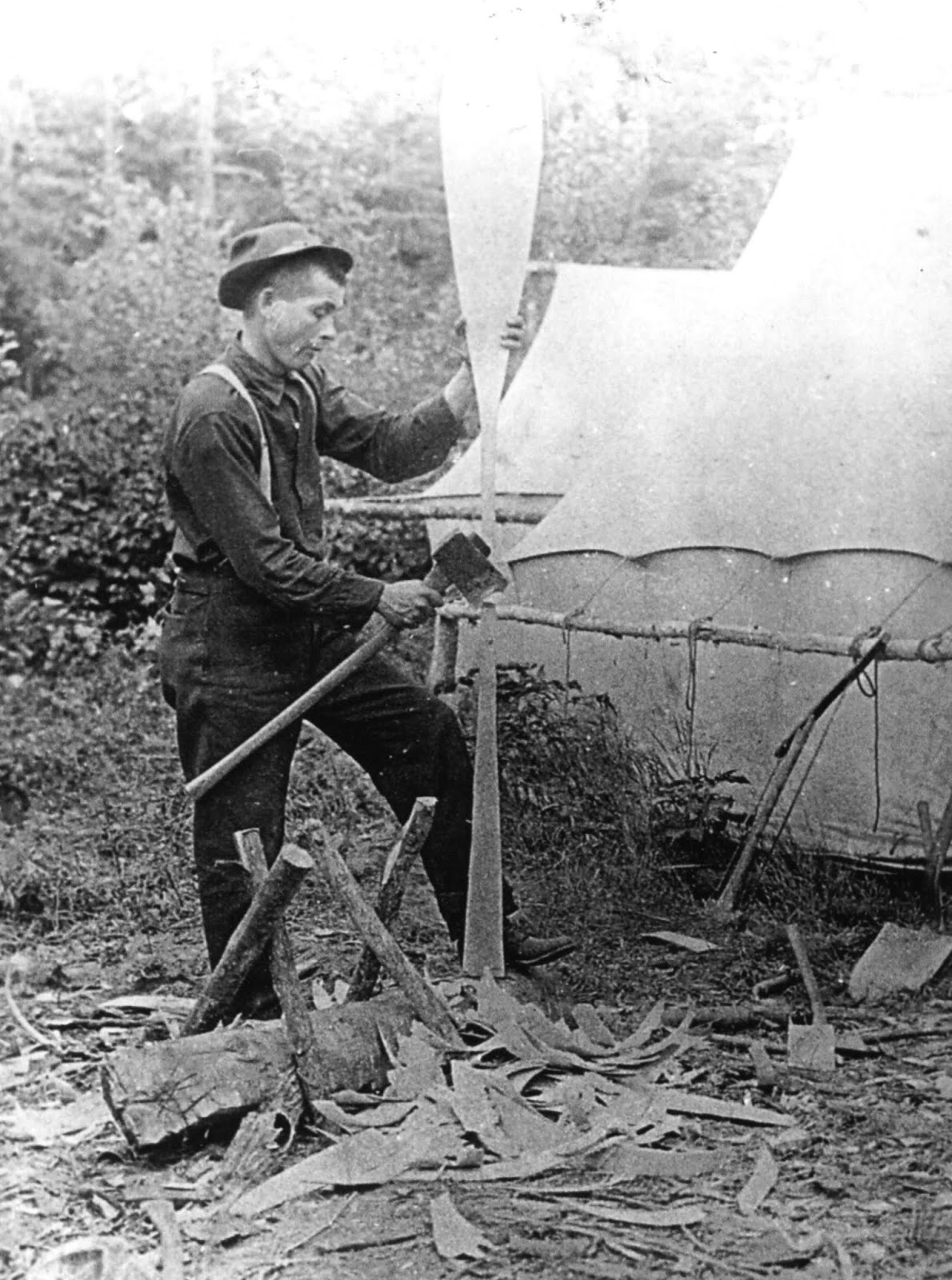
Historic Paddle Photo: Guide Andrew Nicholas Penobscot / Maliseet Paddle

Here's a beautiful historic pic of native guide Andrew Nicholas (November 1, 1869 - July 10, 1935) in the act of carving a paddle with bushtools...


A brief bio online mentions Nicholas was born at Chesuncook, ME and worked  primarily as a sporting guide. Through living in Penobscot territory his heritage was Maliseet from the the L'isle Verte region of Quebec.


Tuesday, August 25, 2020

St. John River Malecite Replica

With the Covid19 issue taking over life here, it's been a challenge to get any work done on paddles between all the necessary isolating in addition to home-schooling my two boys. Many lingering projects from last summer have gone unfinished. One such paddle project is a replica of the circa 1860's Woodland paddle with a unique reverse stepped grip originally featured in this post here.

NORTHEASTERN WOODLANDS (Malecite?) CANOE PADDLE
Circa 1860
5 ft. 3 3/4 in.
Maple
This paddle was collected in the St. John's River area of New Brunswick, Canada. Floral designs are incised on the top.
Originally from the Estate of Herbert and Patricia Wellington of Locust Valley, NY


I didn't have any birds-eye to work with, but just used plain soft maple. Here is a photo from the end of last summer. A little work needed to be done on symmetry and the grip area, but the paddle was progressing well.

1860 St. John River paddle in soft maple

The grip area of the original is actually asymmetrical. One side has a defined lip at the top while the other simply smoothed over. This second side also has a some basic chip-carved elements in the form of vines and dots.


In addition there are a series of incised lines with the number varying from one to three depending on the side of the grip face. Using a chip-carving knife and some abrasive cordage, I formed these interesting carving features on the grip and then burned a reproduction of the carved elements. In keeping with the original, the top station of the grip was not carved to perfect symmetry either, with the left a little more indented than the right. I like how these truly hand made paddles were carved with such imperfections that really are a reflection of mechanised construction.


Like many of the reproductions I've been doing lately, I burned many of the details onto one side of the blade. 


The original plan was to stain the very bright and plain maple wood to a more honey tone, but that will have to wait until time allows some experimentation. 


Monday, January 27, 2020

AFN 2019 Meeting. St. Mary's First Nation

Here are some beautifully captured photos featuring birchbark canoes and Maliseet (Wolastoqey) paddles from the Opening Ceremony of the 2019 Assembly of First Nations Annual Assembly, held in Fredericton, New Brunswik. Full article and more at this link here. All photos credited to Logan Perley, a Wolastoqi journalist from Tobique First Nation

The first image below features National Chief Perry Bellegarde, New Brunswick regional Chief Roger Augustine and St. Mary's First Nation Chief Allan Polchies canoeing across the Wolastoq (St. John River). The classic, pointed willow-leaf blade design is visible in the bow.

Photo Credit: Logan Perley

The three Chiefs apparently started in St. Mary's First Nation (Sitansisk) at the old powwow grounds and paddled across the waterway to the grounds of the Beaverbrook Art Gallery. This photo showcases the sleek lines of traditional Maliseet canoes.

Photo Credit: Logan Perley


The Chiefs were accompanied by the Brooks family who were involved with the repatriation of the Grandfather akwiten canoe, posted about earlier here and here.

Photo Credit: Logan Perley

Photo below features the brooks family taking part in a water ceremony. Prominently included is a beautifully carved set of paddles.

Photo Credit: Logan Perley


Monday, August 19, 2019

Summer 2019 - Working on new paddles

Any morsel of free time was spent working on paddles this summer. At the moment, I have 3 distinct designs being worked on. First up is a 58" replica of the circa 1860's Woodland paddle collected from the St. John River area in New Brunswick featured earlier in this post here.

NORTHEASTERN WOODLANDS (Malecite?) CANOE PADDLE
Circa 1860
5 ft. 3 3/4 in. 
Maple


I didn't have any birds-eye to work with, but just used plain soft maple. Still have to work on symmetry and the grip area, but here is the progress so far. It will likely be stained to match the honey-toned patina of the original.

1860 St. John River paddle in soft maple

Simultaneously, I've been working down a choice piece of spruce to make a reproduction of a pole grip Cree paddle dated to circa 1930-1935. The original with a black painted blade is in the Musee de Quai Branly in Paris, France.

Pagaie
Géographie :  Amérique –  Amérique du Nord –  Canada
Culture :  Amérique –  Cree
Date :  1930-1935
Dimensions et poids :  158.5cm  x 12.5cm, 647 g
Donateur :  Paul Coze
Précédente collection :  Musée de l'Homme (Amérique)
Numéro d'inventaire :  71.1931.44.155

My version was hewn with an axe and turned out ok except for a cumbersome knot at the top of the pole grip which created a slight bulge in an otherwise straight shaft. It was easily worked down with a crooked knife creating lots of wood shavings and bits for the evening camp fires.

c1930-1935 Cree Paddle in spruce


The inspiration for this final paddle is an illustration by famed Canadian artist, Arthur Heming (1870-1940), who travelled with voyageur brigades at the very end of the fur trade era. This specific artwork depicted a hardy voyageur  climbing up a steep slope with a tumpline loaded with a crate and large sacks of supplies. A narrow paddle with an oval bobble grip acts as a support stick.


This particular illustration was selected to visualize a description of a tough uphill portage by the canoe party in J.W. Tyrell's Across the sub-Artics of Canada, published in 1898 and available on Archive.org. Heming accompanied Tyrell on this trip and sketched many realistic portraits of the crew and environment. It stands to reason that the accomplished artist drew this paddle design from a realistic sample in the field.

My version was made from a narrow basswood board and also worked down with a crooked knife and spokeshave. Still not finished yet but it is coming along...

Heming Voyageur replica

Here are all three paddle side by side for comparison. Interesting to see that in their raw states, they all have similar pale tone. 
2019 Summer's work so far



Sunday, September 30, 2018

Historic Paddle Photo: Grand Lake New Brunswick

From the Maliseet Album of  Native North American Indian - Old Photos...


Friday, September 21, 2018

c1860 St. John Maliseet Paddle Replica - Part 1

A long time in the making but finally got around to starting another vintage replica. This one was based on circa 1860 paddle collected in the St. John River area of New Brunswick. It appeared in the Stair Galleries auction site (May 23, 2009 Past Auction catalogue - Lot # 110).


NORTHEASTERN WOODLANDS (Malecite?) CANOE PADDLE
Circa 1860
5 ft. 3 3/4 in.
Maple
Estimate : $700 - $900
Realized : $2,500
This paddle was collected in the St. John's River area of New Brunswick, Canada. Floral designs are incised on the top. 


The paddle was also featured in a long out of print exhibition catalogue - Pleasing the spirits : a catalogue of a collection of American Indian art by Ewing, Douglas C (1982) - plate 474. Luckily one copy of this out of print exhibit catalogue was available at the Toronto Reference Library where I went to find some extra information. The black and white pics included a closeup of the floral carving details etched on the grip of the not featured on the auction images.


Basic Floral Etchings on grip


The original was made from some beautiful Birdseye but I was only able to source out some plain soft maple. Still progress is being made. Here is the paddle with the blade and grip being worked on...


Tuesday, April 3, 2018

McCord Museum 19th Century Eastern Woodlands Paddle Replica

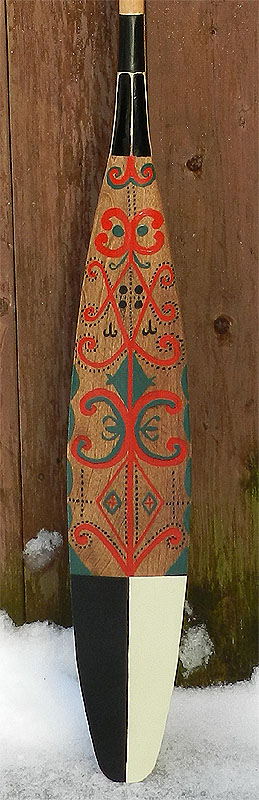
Artifact M5470 at the McCord Museum is a beautifully decorated, 19th century paddle. It has been identified as "Eastern Woodlands" (either Passamaquoddy or Maliseet) and features an array of painted double-curve motifs as well as a divided black and white blade tip.


Anonyme - Anonymous
Eastern Woodlands
Aboriginal: Maliseet or Passamaquoddy
1875-1900, 19th century
11.4 x 150 cm
Gift of Mr. Hobart William Molson
M5470
 McCord Museum


Many years ago, I adapted the decorative pattern for a yellow birch paddle with a more narrow blade profile. This time I tried to be true to the original design and replicate with paint and stains despite painting not being my strong suit.

At 150cm (59 inches), the original paddle was already near to my preferred paddle length so adjustments weren't necessary. As before, I had a piece of Yellow Birch stock to use up. Yellow Birch can be unpredictable sometimes when carving or hewing with an axe. This piece went well except for a small bit of tear-out by the throat. As a consequence, I had to use a little bit of Quikwood Epoxy putty to fill in the tear, but most of the damage would eventually be covered by paint.

Epoxy putty repair to throat

I've been experimenting with painting using oil-based Tremclad paints which are available in smaller sample sizes.  Of course the modern formula isn't like traditional oil-based paints used in the 19th century and mixing up authentic batches is beyond my skill set. These rust paints flow thick and harden to a waterproof finish so the paddle can ultimately be oiled rather than varnished. I ended up using some Flat Black, Recreational White (a cream colour), Fire Red and a custom green made by mixing their Yellow with a dark blue spray paint I had on hand.


Painted blade

In addition,  the blade of the original paddle seems to have darkened compared to the shaft. To mimic this effect, I used Minwax Gel Stain (chestnut) after finishing the paint job.

McCord Replica Blade - stained

The shaft was left natural and the whole paddle oiled. Here is the final result...

McCord Museum 19th Century Replica 


Saturday, March 17, 2018

Pitt Rivers Museum: Woodlands Canoe Paddle circa 1858

Item number 1886.1.866 in the collection of the Pitt Rivers Museum is a "Woodlands" paddle dated to at least 1858.  The paddle is described as having a leaf-shaped blade and decoratively carved band on handle. 

Place details: N AMERICA. Canada. 
Cultural Group: NE ?Subarctic ?Woodlands E Algonquian
Dimensions: Max L = 1945 mm Max W of blade = 164 mm
When Collected: On or before 1858 Acquired: Transferred 17 February 1886
Source Link
 © Pitt Rivers Museum, University of Oxford

Both the blade shape and the slender, elongated handle with its indented grip face seem very similar to the circa 1849 Passamaquoddy paddle recently on display at the Peabody Museum (previous post here)


Grip of c1849 Passamaquoddy Paddle
Peabody Museum
Photo Courtesy of John Fitzgerald

I've begun to carve a similar paddle (out of yellow poplar stock) to replicate this design.


Thursday, March 1, 2018

Mawi' Art: Charlie Gaffney Etched Paddle

Mawi' Art is an Artist Collective that features various forms of Atlantic First Nations art and crafts. The section on carvings and sculpture features an image of Wolastoqiyik (Maliseet) Visual Artist Charlie Gaffney working on an incised paddle...

Charlie Gaffney Etched Paddle


While perusing the paintings section of the site, I came across a mural by Natalie Sappier featuring a canoe related theme with decorated paddles.

Natalie Sappier


Friday, October 6, 2017

Musee Civilisation de Quebec Paddles

The Musee de la Civilisation de Quebec (MCQ) has recently updated their web interface and online  database and they have some wonderful, full-sized paddles in their collection. The database required searching using the French words "pagaie" and "aviron" but revealed some antique designs of various tribal affiliations.


Abenaki Paddle
Mid 19th Century
 162.7 cm x 14.6cm


Huron Wendat
 159.2 cm x 11.7 cm


Lac St. Jean Innu
Inscription painted in dark beige and red:
LAC ST-JEAN 1889.
160.5 cm x 9.0cm


Malecite
Mid 19th Century
 170.2 cm x 16.7cm 


One unusual design is a square bladed Mi'kmaq paddle with different thickened shaft design at the midpoint, presumably to increase strength.

Square tip Mi'kmaq
Mid 19th Century
 145.0 cm x 13.8 cm


Older Posts Home Page