Wednesday, June 16, 2010

Jasper Grant Paddle

Found some more info on a historic paddle in the Toronto Reference Library Archives. This one is a full sized souvenir paddle which eventually ended up in the National Museum of Ireland. It was made for Colonel Jasper Grant, an Anglo-Irish Officer stationed in the Eastern Great Lakes region between 1804 - 1809. Both sides of the blade a decorated with depictions of native scenes including dancing men with tomahawks, a solitary man with a tripod and cooking pot, and some figures paddling a canoe. One freight canoe has what looks like an HBC flag at the stern, you can just make out the cross marks of the Union Jack.

Blade Decorations


Sunday, June 13, 2010

MEC Paddle Fest

This weekend was the annual MEC Paddlefest held at Sunnyside Park, a quaint little part of the western beaches in Toronto. I swung by to help out a bit with the Wooden Canoe Heritage Association booth and hopefully see some other creative paddles. My little man accompanied me for a bit with his Mini Maliseet paddle in hand


Checking out the paddlefest

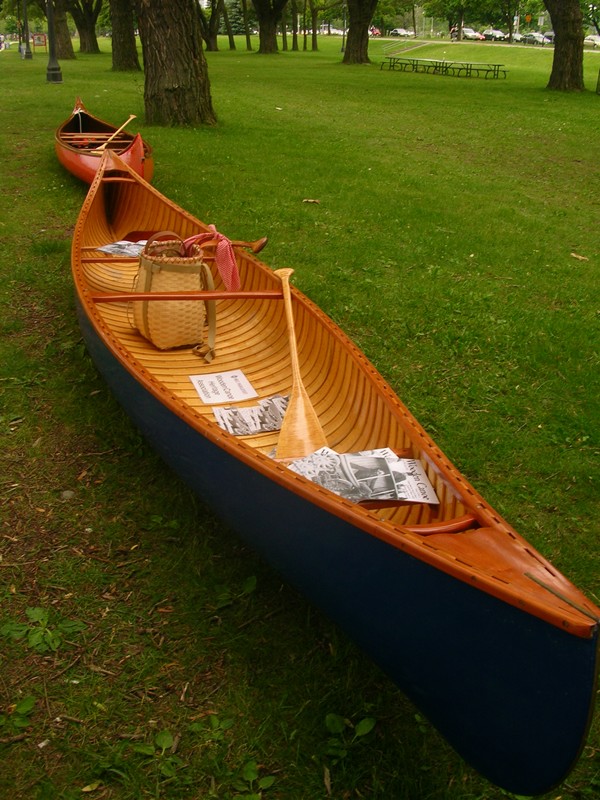
The weather didn't cooperate and the threat of thunderstorms and grey skies seemed to have limited the public turnout. It also didn't help that the supposed booth that the WCHA booked never materialized. In the end, their display was next to the Canadian Canoe Museum booth nestled rustically under a large tree.

Got a chance to meet other local members including Alex G & Rob S of Hamilton. Rob makes great Wannigans, had a packbasket on display, and is the distributor of traditional canoe gear like fire irons and reflector ovens - really fantastic stuff. Leaning against the tree was a hearty voyageur paddle made from walnut with a thick, beefy oval shaft.


Rob's Walnut Paddle with decorative sash

On Saturday, John Summers, the GM of the Canadian Canoe Museum was on hand doing some paddle carving and was kind enough to share some sharpening tips for the Stanley contractor spokeshaves that he was using. When I was able to swing by late the next day (after helping my cousins move on Sunday morning), Hal Bowen was taking over the reins on the shaving horse. Hal was one of the original instructors at the CCM paddle carving course that started this whole hobby of mine. Very nice to catch up with him again.


Paddle Carving on the beach

Rob's W/C boat and John's 1937 Old Town Sailing Canoe (apparently with orginal canvas) were there as demo boats. Wanted to bring my own canoe down, but logistics limited my ability to transport it down.


Some W/C boats on display

Badger paddles had their colourful display as part of the Swift Canoe booth and every time I tried to get a shot, there was always another customer in the frame checking out the designs. Got a chance to quickly meet Mike Ramsay and thank him for the Badger Paddle Sock he sent my way a while back. Really dig their orange paddle for extreme visibility. Might be appropriate for late season paddling during hunting season.


Badger's Paddle Racks

While the bulk of the show was devoted to plastic kayaks and new trends (including Stand Up Paddle Surfing), there was an intriguing booth showing off traditional greenland kayaks and paddles. Unfortunately lost the business card with name and details, but here's the pic...


Greenland Kayak & Paddles

The next paddling event I'm hoping to attend is the National Canoe Day celebration in Peterborough on June 26th.


Thursday, June 10, 2010

Reshaped Birch Cree Paddle - Part 1

Just around the corner from home, I spotted an amateur "Antiques for Sale" sign pointing to an industrial warehouse. Intrigued, I went inside and found a huge haphazard collection of stuff that had seen better days. I was on my way out when I saw the shape of a paddle behind a pile of rusty tools. It turned out to be a half-completed, 57" paddle blank made from what appears to be yellow or white birch.


The partially complete Birch blank

The wood stock seems to have been 1" thick as this is the maximum thickness of the shaft. Not ideal for a heavy use paddle, but still workable for light use. At least the grain in the shaft is well contained and runs perfectly parallel down its length so the original builder was either lucky or knew exactly what was needed for paddlemaking. The bulk of the blade had been power planed down to about 1/2" with some noticeable areas of tear out but these should be easy to clean up with some spokeshave work. A small, crudely shaped pear grip had been rasped out. Basically the hard work had been done and now only final shaping needed to be completed. In pencil along the shaft was the name "Skyler". It seems someone started this project but then abandoned it. The paddle was mine for $5 and I immediately began visualizing reworking it.


Small Pear Grip

My first observation was how huge the blade area was relative to the length and this caused the paddle to be extremely blade heavy...not ideal. The 5.5" wide blade had a beautifully rounded tip and I wanted to preserve this feature. But to make the paddle more balanced, the blade area had to be reduced. After being please with the Attikamekw design as a favoured solo blade, I wanted to try another close style to this slender shape. In particular, I've been eager to try some of the Cree Style paddles I've posted on before.


Cree Paddles - Canadian Museum of Civilization

In the end I chose the sweeping, recurved blade design of the middle paddle. After marking out some of the basic points on the blank, I used some clamps and a flexible metal ruler to draw out the curves. Here is the result...


New blade shape marked out for cutting

The Mrs. did some planting and cleaned up the balcony last weekend. I can tell she doesn't appreciate the wood dust and shavings in her flowerpots, so in order to minimize any domestic disturbance, I headed to the nearby park with the paddle, a saw, and my two crooked knives. Rather than saw out the entire paddle shape, I thought I take a shortcut and make some perpendicular cuts, chip out the rough shape, and clean it up with the crooked knives. While I had brought both knives to the park, the recently completed Orien Knife outperformed by own homemade version, mostly because of the steeper bevel being better suited to the kiln dried hardwood, birch stock. Here's where the paddle stands now...obviously not an exact replica but I had to work with the limitations of the existing dimensions.


Chipping out the outline; Cleaned up with the crooked knife

The sharper angles will be eventually worked down. But it's a funky shape and I'm curious to see how it'll perform.

SEPT 21, 2010 UPDATE: Paddle is now complete and decorated. See post HERE


Wednesday, June 9, 2010

Exotic Paddle Series - Dayak Borneo Paddle

From this EBay source is an exotic paddle is used by the Dayak tribes of East Kalimantan, Borneo Island. The seller mentioned it was carved from one-piece hardwood (no species name provided) and is decorated with an extremely rare and traditional pattern motif. The short paddle only measures 44 inches in length and the width is mere 2.25 inches. Check out the indented T-Grip...


Dayak Paddle; Blade Etchings


Closeup; Interesting T- Grip

Decoration and origin aside, it is quite similar to the dimensions of my Walnut Nuthatch Experiment paddle made from a scrap piece of walnut. A very slender and flexy solo paddle which has limited practical usage but still a good use of the valuable walnut cutoff

Seller: Asia191


Sunday, June 6, 2010

Canoe Pole Project: Part 1

I've convinced myself to attempt another canoe-related project with basic carving tools. Lately, I've been fascinated by the poling videos on the NorthWest Woodsman site. Footage of him pushing his way up remote, shallow creeks made me want to pursue this part of the canoeing experience even more. After purchasing a cheapo ex-library copy of the classic books, Pole, Paddle, & Portage by Bill Riviere, I was convinced that I should at least try making a spruce pole.

Andy Hutyera's post on the Wooden Canoe Forums discusses plans for a canoe pole in detail, although these seem to focus on power tool usage, table saws, routers...not my cup of tea. More info the following PDF files...
• Making a Canoe Pole
• Poling A Canoe

A few online sources, including this descriptive one, make mention of using a prefab curtain rod from Home Depot, the aptly named "Home Depole". Others write about finding the perfect dead standing spruce tree with the perfect dimensions to chop down and finish with a crooked knife. My option found the middle ground...I ended up using one of the extra 12 ft long, 2x10 boards purchased to make the bark canoe building bed. It has been cluttering the garage floor for some time but I wanted to save it for something.

As luck would have it, there were no knots in the relatively straight grained portion 2 inches from the squared original edge. A chalkline was marked 1.5" from this edge, but later, I ended up marking out the future pole using a combination square for more accuracy. I also marked out other areas where poles could emerge, but all of these had some knotty flaw somewhere along the length. In the end, the wood was easily (but not evenly) split to reveal the rudimentary birth of canoe pole


Original board; Split out piece

Not as elegant as ripping an even piece with a circular saw, but with my growing aversion to power tools, this was the most appropriate manner to liberate the pole from the board. It was worked down with an axe, loading up chips in the communal fire pit and then further cleaned with the crooked knife.


"Semi-Old Fashioned" way of making a pole

The project gave me the first opportunity to try out the recently made Orien Blade crooked knife. The blade's offset and "crooked" blade angle took some getting used to. The blade was very sharp but tended to pull out the wood in scoops (a flaw in my technique for sure). In the end, I ended up using my flatter, home-made blade crooked knife to work down the edges. The pole is still a work in progress and will need to wait until my next trip up north to finalize.


Silent tools for the job


UPDATE: Pole has been completed - part 2 has been posted here



Newer Posts Older Posts Home Page