After posting about my interest in attempting the old school
pack cloth technique I got to work using some of the material I have on hand. First off here is a writeup of the components...
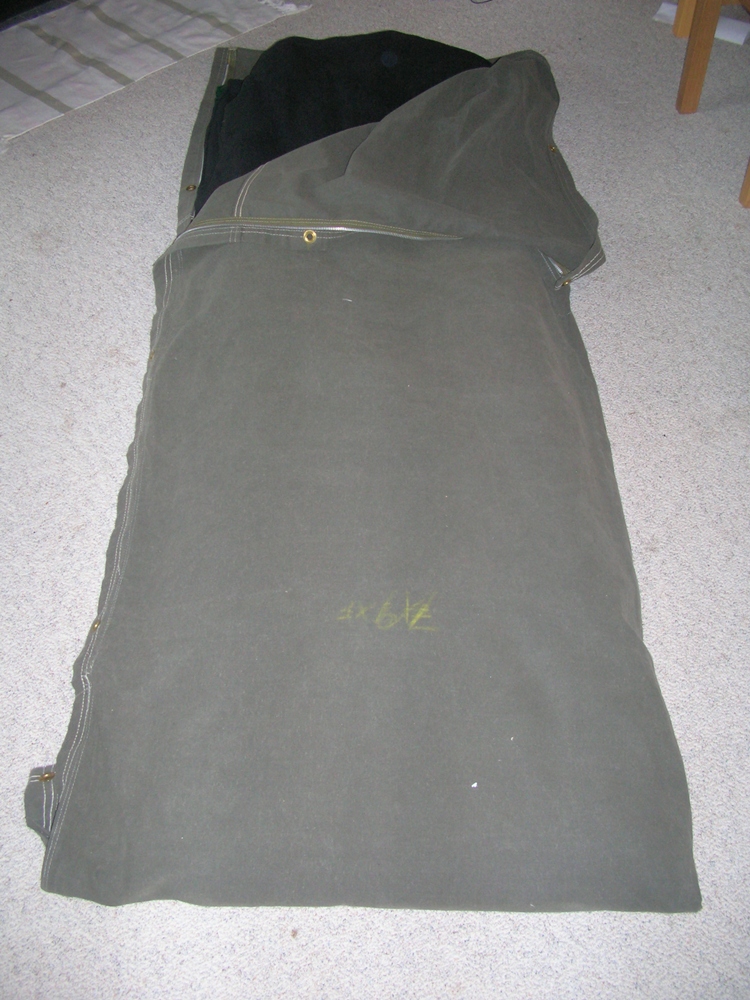
Canvas tarp bedroll cover
A while back when the Canadian dollar was nearly at par with the US, I purchased a homemade canvas bedroll off of Ebay. My intention was to use some wool blankets and have some nice bushcrafty like sleep with an open fire. The maker simply took a 12oz, 7'x9' firetreated, marine tarp and stitched up the bottom. He added a large military zipper up the side. Seems like he might've been desperate to sell, because I won the bid for just $40 with a very reasonable shipping fee. Just the tarp alone costs around $70 around these parts.
Canvas Tarp Bedroll
Inflatable Sleeping Pad
Last summer I had planned to do some basic car camping with my elder son. Since I usually go solo and use a hammock system, some new gear was necessary. After researching new tents and some inflatable sleeping pads, I decided on this heavier (but comfortable)
MEC Super Reactor double pad to ensure we both had some good sleep. Luckily before pulling the trigger on a new one, I found an ad for the same pad being sold off by another father. It had been used once when a bear encounter at a provincial park scared the crap out his daughter. That bear saved us $85 and an expensive parking trip downtown to the always crowded MEC store.
The double pad has a slight seam down the middle where it is folded to fit into its stuff sack. Turns out, the pad can be folded in half when inflated to serve as an ultra luxurious mattress. It fits perfectly into the canvas bedroll cover in this manner
The fully opened MEC Super Reactor Pad
Folded in half before slipping into the bedroll
Sleeping Bag
My sleeping bag is an older generation, MEC Gosling bag insulated with down and rated to +5C. I've used it hammock camping in a Hennessy Hammock and have always been quite happy with it. In addition, I've also used a fleece liner bag to increase the warmth when the temperature drops. While not in the picture below, the fleece liner can be seen in the indoor bedroll photo at the beginning of the post.
Pad and sleeping bag inside canvas bedroll
Pillow
Instead of dropping more funds on commercial camp pillows, I use an old laptop computer sleeve that has fuzzy fleece on the inside. Turn it inside out, stuff it with spare clothes and it works just fine
My comfy pillow
Waterproof Ground Cloth
This was just a common 6x8 poly tarp to serve as a waterproof outer layer in my bundle.
Missing: Shelter Tarp
The one component missing in my attempt is the shelter tarp which in fact would be rolled up as the "pack cloth". I've been working on making my own (cheap) canvas tarp for occasional usage and a new post about that will be coming soon. In the meantime, I went ahead and used the 6x8 green poly groundsheet as my pack-cloth just to see if it could be done. Below are the steps I used and the result...
Forming the Pack Cloth Bundle
The canvas bedroll with its inner components was zipped up and placed in the centre of a 6x8 poly groundsheet with the excess canvas material tucked under leaving about 12" or so of tarp and the top and bottom
The tarp was folded over at the head and foot of the bedroll and then the tumpline was layed down like described in the readings, with the "tails" running down the side of the canvas bedroll and extending out past the bottom of the tarp
At this point the sides of the poly tarp are folded over to the centre of the bedroll. Given the slippery nature of the synthetic poly tarp the whole thing started opening up in the middle. I suspect when I repeat this with a larger canvas tarp shelter (another work in progress), there will be more overlap and protection.
Now the head and foot of the bundle were folded over to the centre point like so...
... and then the head part folded over again. You can see that the tumpline strap from the headband and the tail are now right next to each other.
While holding onto the headband strap and straddling the bundle between my legs, I pulled on the tail piece and watched as tarp began to tightened up. At this point, the tail piece was secured with a tump knot (basically a figure 8) and the procedure repeated on the other side
With the sides tightened, the tails were brought over to the centre of the bundle and crossed.
The bundle was rolled slightly and the tails tied off.
Here's what the completed bundle looked like.
In retrospect, I should've been more careful with aligning the headstrap at the beginning of the process, because it ended up a little off centre. Something to know for next time.
Once it was all tied up, I wanted to give it a whirl and see how the bundle carried in the canoe along with the
wanigan. Here is everything loaded up along the shore of the cottage lake.
The bundle fit snugly under the gunnels just forward of the centre yoke, although it wouldn't have much room to move if I needed to shift the gear forward.
While using the pole the bundle got wet from the splashing and such but the tightly wrapped poly tarp did its job in protecting everything inside. I think for a quick poling overnighter trip, this system might be a fun method although I'm not confident it would be completely dry in a prolonged submersion.
Here's a view poling in some shoreline shallows amongst the lilypads.



 Email this post