Sunday, August 26, 2018

Fantastic Birchbark Canoe Raffle Happening Now

Paddling friend and Artist, Mike Ormsby has organized a fundraiser where the prize is a chance to win an authentic 13' bark canoe built by two well known builder's from Maniwaki Quebec - Jocko Carle and Basil Smith! These two builders were featured in David Gidmark's publication Building a Birchbark Canoe - The Algonquin Wabanaki Tciman.


Jocko Carle & Basil Smith Raffle Canoe
Addition photos: Facebook Album

The canoe is in great shape considering it is nearly 50 years old. It is constructed with a single piece of bark (rare these days) and needs some new lashings, a thwart and some re-pitching. If the fundraiser is successful, Mike will restore the canoe to be water worthy. Proceeds from the fundraiser will go towards future First Nation community canoe builds.

Tickets are just $100 and 100 will be available. A 1-in-100 chance are great odds for winning this boat. Mike is asking for payments to be done by e-transfer to bildcanoe@gmail.com or through PayPal. So far just 15 of the 100 have been sold and a deadline is approaching. So anyone interested in this chance should move fast.

Additional information or to contact Mike through facebook, check out this page HERE.


DIY Marsh Pole Shoe

For quite sometime, I've been wanting to make an accessory for the two piece spruce pole carved back in 2017. My occasional day trips poling around involve rocky river & creek bottoms where the homemade copper pipe and lag bolt shoe works fine. Often though, I want to explore marshy areas where a typical pole shoe get stuck in the mud and becomes less effective as a propulsion tool.

Commercial duck bill type pole ends exist for fishermen and hunters wandering into mucky territory, but rather than invest in more plastic gear, I have been interested in an alternative solution called the "Crow's Foot". Here's an image of one on the bottom right.


A simple accessory made of wood, the profile of the foot is supposed to increase surface area so the pole doesn't sink to deep into muddy bottoms, while minimally interfering with forward momentum. A few folks online have posted that they've used homemade versions with decent results while commenting that that foot also acts as a bit of rudder to help steering.

Before his online images disappeared, I saved Matt Hopkinson's pics of the foot being used by native groups in the swampy Florida Everglades...


Matt also shared his idea for securing the Crow's with a tensioned cord and a small metal brace that fits through the bolt at the bottom of his aluminum pole.

Matt H's Crow's Foot Attachment


I adapted Matt's method for my own wooden pole by using up some scraps. My crow's foot is from a piece of yellow birch with a notch cut in to hold a strong velcro buckle tie. I found an old piece of metal bracing with a large enough hole so the 5/8" lag bolt could fit through. It was simply screwed to the bottom of the foot with whatever old screws I could find. Looks ugly but it works


The friction fit and velcro strap hold the foot on pretty tightly but  the great thing about this method is that the Crow's foot is not permanently attached to the pole so it can be removed easily once out of the mucky terrain. That way, a dedicated marsh pole is not needed and I can continue using the pole for more commonl rocky terrain.


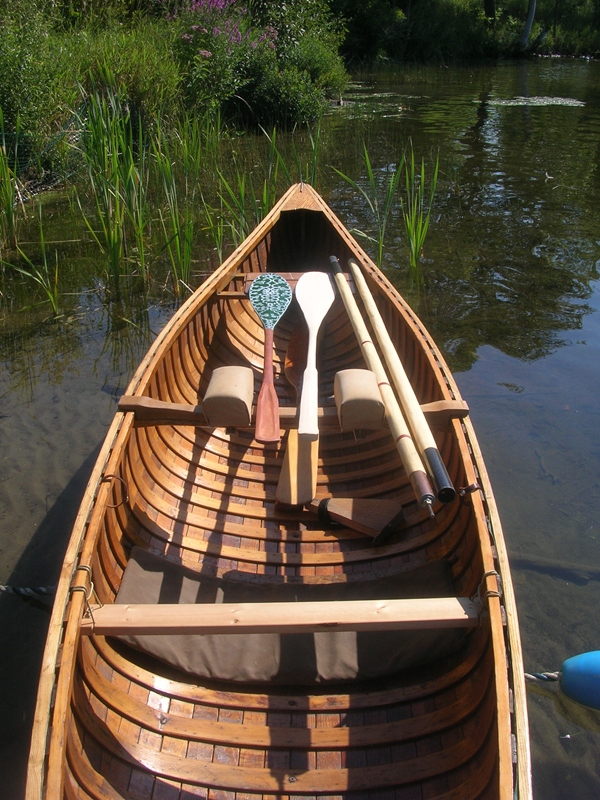
Eventually the birch foot will be painted or varnished to give it a bit more longevity, but being eager to test it out, I headed out to marshy wetland out on the cottage lake where the water levels shallows out to about 2 feet and the lake bottom is thick mud. Here is the canoe loaded up with the Green Passamaquoddy paddle and another one in the process of being carved (maple). 


Once at the wetland, I attached the Crow's foot to the pole and stood up ...


The foot worked perfectly! The pole was not getting stuck in the mucky bottom and I could easily push the canoe around. Since I was alone, the only shot of it in action I could take was a twisted angle of the foot submerged in the murky water. Standing up in a canoe while poling and taking a photo with one hand isn't easy!


Anyway, quite happy how this little bit gear will make poling in marshy zones much more enjoyable. Thanks Matt H for the helpful advice.


Friday, August 17, 2018

Paddle Photoshoot

Our family has been away at the cottage for the last little while enjoying some much needed disconnect time from the city. Paddling options were limited for me, but I did get the chance to take some older designs out of a spin along with a few newer  models that had yet to be dipped in water.

Paddles Left to Right:


Also found a huge patch of water lilies to take a couple of these shots ...


Friday, August 3, 2018

3 day Father & Son Trip - Year of the Deerfly

Got to spend some quality outdoor time with my older boy on our annual father son trip.  For the last 2 years, we've been visiting the Haliburton Highland Water Trails (formerly Frost Centre) to explore these well maintained waterways. If you missed them the first time they were posted, those trip reports can be read here and here.

I had planned to take him further north on a more adventurous route to the Temagami area for some Crown Land camping but a large chunk of the area came under a voluntary evacuation due to serious forest fires. About 100 kids from the famed Keewaydin camp even had to be evacuated to North Bay

Given these conditions, we decided to make an easy trip to familiar waters so we went back to the HHWT. The summer has been hot and dry and we went in knowing the area had a daytime fire ban. Turns out the day we paddled in, a large swath of the region (including Algonquin Park) declared a total fire ban so no campfires in the evening either.

Brought along the wanigan and a few other bits of homemade gear including his custom paddle made last summer, folding bucksaw chair and our trusty set of oil tanned leather moccasins. Along with these heavier luxuries, my little guy wanted to bring his acoustic guitar for entertainment so I didn't want to do something too excessive. We had anticipated one night at the far end of the access point lake then we would paddle a short stretch of river, take two easy  portages (less than 100m each)  over to the next lake for an additional two nights. 

We arrived to an near empty lot with only one other vehicle parked at this normally busy access point. Glorious weather was predicted for the week so the fact that we would see only one other group was a nice surprise.

Paddling in

After a leisurely paddle down the lake, we explored the campsites along the route for future reference. In the end we ended up with a nice peninsula site tucked in its own private bay that had two tiers of elevation and a large rocky expanse to lounge around.

Rocky spit and easy waterfront access at site


We set up our tent under a large pine by the shore and also hung our water filter system on a cut branch stub. Some  flat boulders near the tent pad served nicely as a bench. 


The rocky frontage had many little points where the lake depth dropped quickly. After helping out with the site setup, my boy grabbed his rod and started casting right off the edge.


No bites at this time of day, so he decided to take out his guitar and jam. Can't quite see it in the photo below but there was a loon in the distance serving as his lake front audience. Got a couple of loony wails when playing some acoustic AC/DC.


While he was rockin' out, some food was prepared and I got to enjoy a mid-day cappuccino in a new camping cup. The cup was made from a split coconut shell sanded down to remove all the hairs and a piece of antler for the handle. Holds a good 1-1/2 cups of fluid...

Coconut Kuksa Cup


After a nice shore lunch by the breezy shore, I surprised my boy with some bushcraft gear I made over the off-season.

New camping / bushcraft gear


The set included his very first "real" knife & firesteel combo. Up until now he's been playing and practicing with a wooden set made a few years back. Used a Helle Fjording blade (short 70mm = 2-3/4 inch long) with a walnut bolster and elk antler handle. Also tried a different sheath and belt loop design with stamped markings and his initial. The pointy tip from the antler piece was re-purposed as a handle for his own ferro rod. Leather scraps were stitched up to make a belt holder.

Also ended up making myself a new knife using a very affordable Condor Woodlaw blank. The olive wood scales came from my Great Uncles property overseas and was from the same tree that I used to make one my crooked knives back in 2009. Decorated the handle with a bit of pyrography and made an accompanying dangler sheath - a very comfortable design for canoe camping when you need to kneel in the boat.

Anyway, my son loved his new kit. He wanted it on his belt right away and pretty much kept it on for the rest of the trip. 

Proud little bushcrafter


Later in the evening when the wind died down we tried our hand at fishing as well as exploring a wetland for any wildlife.

Exploring a wetland for  herons


No luck fishing


Day one ended well and the following morning a beautiful mist was rising off the lake. 


The mosquitoes were out at this time, so with armed with a bug jacket, another attempt at fishing was made while breakfast was being prepared.

Early morning misty fishing

No bites again so the patient fisherman wanted to paddle and explore another section of the lake. The mosquitoes weren't quite as bad by this time but the deer flies came out in aggressive hordes. Never been bothered by bugs in all my years of camping but have to admit this year's deer fly scourge even got me frustrated.


Time had come to pack up and move to the new campsite (the same one I stayed on during my solo trip last fall), but the thought of dealing with the blood thirsty deer flies on the paddle over and portages through the bush didn't seem too much fun. So far we had the whole lake to ourselves and despite being booked on another site, we decided to bend the rules and stay on being ready to move on if anyone came.

I was going to keep our bug shelter at home and just rough it with bug jackets. At the last minute, my boy mentioned we should bring it just in case. He even moved stuff into his pack so we could make space for this bulky piece of gear in the main pack. In the end it was a super smart move!

We set up in an elevated part of the site and this became our home to cook and relax in relative backcountry comfort.

VCS 13 Bug Shelter = total necessity in the year of the deer fly


The wanigan proved to be a great practical use on this trip again. It was our kitchen, our table and our entertainment centre. The chess set I made with wood scraps and the inner tray got lots of usage. My son played lots of chess at school this year and decisively beat me every single game.


"You should stick to making stuff instead", he said.

That reminded me of another camp gift I made buried deep in the pack. Years ago spotted a design on the BushcraftUSA.com site of a folding canvas and leather pouch. I stitched the sack from a scrap of dropcloth tarp and attached the leather components that serve as a belt loop and cover. Explained to him that he could keep the pouch folded up on his belt and then open it up to throw-in whatever he collected. Here's a shot of the "Dump Pouch" on his hip.


With bug shirt back own, we explored the thick bush behind the site to find various forms of tinder. I gave him a challenge to try and find things that he thought he could light with a spark from his ferro rod.


In the end he collected some dried sphagnum moss, old man's beard lichen, reindeer lichen, a pine cone, and some birchbark.

The fire starter collection

Given the total fire ban, we packed these up to bring back home and experiment in the safety of the backyard back in the city. Another trip is in the books and hopefully we'll get some more family paddling in later this summer.



Sunday, July 22, 2018

2018 WCHA Assembly Highlights

Just concluded a wonderful 4 days in wooden canoe heaven at this year's WCHA Annual Assembly in Peterborough, Ontario. Given the family obligations I needed to commute from home each day but the whole event was quite worth it. Due to our extremely dry summer, the normally lush grass turned into a field of dried yellow, but the canoes on "The Green" were nonetheless quite stunning.


The theme for the event this year was Chestnut Canoes and a wide variety of these classic Canadian icons were out on display on the lawn.  

Chestnut Chum complete with wanigan and Woods canvas pack


A Chestnut Bob's Special, and a few Prospectors


1930s Chestnut Bob's Special with beautiful heart shape decks


A new Canadian attendee to the assembly brought in a very old Chestnut cruiser that has been pretty well cared for. The owner installed a new centre thwart to carry it, but the seat and thwart placement is what was found in older boats. I overheard expert Dick Persson of Buckhorn Canoes assess it as a post-fire, late 1920's Chestnut.


My own little 14 foot Chestnut Playmate seemed crowded with the wanigan and homemade pack basket. On the lawn was a digital scale to help weigh the boats. My little Playmate clocked in at 68.8 lbs without all the gear! Visual evaluation by the experts revealed it has spruce inwales and oak outwales. It'll be needing new canvas and I learned some techniques as well as some creative ideas to get the weight down on this boat. 

My own 14ft Playmate loaded up

Couldn't speak to the owner of the following boat, but it had very interesting outwales with a feature I've never seen before. The ash outwale had a laminated layer of walnut on top giving it a two toned appearance.

walnut and ash outwale


Also fascinating was one of the project canoes on display. Turns out it is the same model as my own Chestnut...another 14foot Playmate being brought back from the dead!

14 foot Chestnut Playmate - "minor repairs needed"

In just a few short days, the hull was regaining its shape. Totally fascinating that an old reject like this could be made to float again.


Pretty boats aside, the real highlight was the chance to re-connect with old friends and make new ones. Craig Johnson and family made the lengthy trip from Ohio. He brought a 1930's Peterborough High End Champlain as well as some his lovely paddles. It was great to get a feel for them in person.


In fact, his wonderfully carved White Cedar paddle was a personal favourite at the show. Weighing in at around 1 pound, it felt like magic in the hands. Craig has apparently tripped with the paddle as evident by some healthy scratches on the surface 

1 pound white cedar paddle


Canoe builder Pam Wedd of Bearwood Canoes was there showcasing her marvelous skills with workshops and some of her boats, including another 14ft Cherish built on the same form as my build from 2008.


Very fortunate for attendees was that paddlemaking master Graham Warren of Moosehead Canoes was able to make the long trek over from the U.K. Graham educated the audience on various ancient paddlemaking techniques as well as his novel ideas with experimental paddle design. Also intriguing to me  was his demonstration of making a paddle by burning a board and scraping out a shape.

Professor John Runciman of Guelph University brought along a series of his own paddle replicas made by measuring various indigenous designs in museums across the continent. While mostly dealing with West Coast and Subarctic designs, there were a few East Coast designs including an etched paddle replica of an Abnaki/Penobscot paddle featured in one of the early posts of the site.


Catalog No: 50.1/ 9826
Culture: ABNAKI, PENOBSCOT
Locale: ME
Regions: EASTERN CANADA, NORTHEAST
Country: USA
Material: WOOD
Dimensions: L:171 W:16.5 H:3 (in CM)
Acquisition Year: 1916 [PURCHASE]
Donor: PAUL, GABRIEL A.


My own paddle display was up during the day time and the presentation on Historic Paddle Decoration hopefully added a different angle to the morning lectures. My older son accompanied me and was a wonderful assistant showcasing our 10 paddle replicas while I spoke. 

Many thanks to the Assembly coordinators and volunteers who made this event possible.


Newer Posts Older Posts Home Page