Sunday, October 30, 2016

Parkdale Maplewood Community Museum: Mi'kmaq style canoe & paddle

The Parkdale Maplewood Community Museum in Nova Scotia has a Mi'kmaq style bark canoe on display.


Accession number: 1946.Y.004 a
Date: 1862 - 1943
Measurements: 750.3 cm; 77 cm; 28 cm
Parkdale-Maplewood Community Museum
As per NovaMuse Educational Policy


According to the description, the canoe was made  by  John "Stephen" Rafuse. The exterior of the canoe has painted a deep shade of green, however the interior remains an unpainted. Root lashings aren't visible and there appears to be a green painted inwale so it is likely held together with nails.

Another shot from the Museum's exhibit page shows the same canoe with a fishing net and an accompanying green paddle...


Parkdale-Maplewood Community Museum


Parkdale-Maplewood Community Museum


Thursday, October 27, 2016

Paddle Fail: Warped shaft on Sassafras Paddle

Hoping that folks reading will learn from my mistakes, I've posted a few failures over the years in this paddle making journey. One such example was my doomed attempt at carving a paddle from a piece of downed cedar or the first sassafras tripper that snapped after aggressively testing the flex.

Well, here's another learning experience to share. After completing a sassafras version of the recurved cree blade,  I had decided on doing a negative burn of the simple original decoration of bars and circles. In order to visualize the result, an image of the paddle was tinkered on with photoshop.


Visualizing the burning pattern

The plan was to do a full on burn with a propane torch on both sides of the paddle with a few spots left bare in order to complete the fine details with pyrography pen. After testing and doing a single side burn on a new Sassafras Tripper this seemed like it would be without problems.

Unfortunately while burning through the shaft area on this paddle, it began to warp ridiculously so now there is a pronounced bend, both curving laterally and back to front as evident from the pics below.


Severe warp of shaft to the right


Shaft bent back from blade

Guess without planning it, I created my very first "bent-shaft" canoe paddle.

Luke McNair had sent a warning about the risk of warping if heat was applied unevenly. Did my best to consciously avoid this, but the results here are pretty dramatic. I suspect the fact that the shaft was carved down to 1" and the blade thinned down more than usual for some flex contributed to the warping. The lumber stock was also flat-sawn instead of being quarter sawn.

Either way, all is not lost. I plan to practice some etching on the burned blade and will figure out some other usage for this failure so the wood (and my efforts) aren't wasted.


Tuesday, October 25, 2016

Katadyn Base Camp Water Filter Mod

Years ago, I purchased a Katadyn Base Camp gravity filter to avoid the chore of manual pumping for fresh water. While it was easy to use, the pleated membrane filter was quick to clog and the clean water flow would basically stop. The inability to backwash the system and the high replacement cost of the filters ($45+ CND) lead me to start using a Sawyer Squeeze system. It has a much better longevity since it can be back flushed easily but the smaller squeeze bags it came with were not ideal for large water needs. 

Both Katadyn and Saywer have since come out with "new and improved" models of their filters, but I'm not a gear head who feels the need to replace perfectly functional things just to have the latest version. The new Katadyn Base Camp Pro costs $120 here in Canada and comes with a redesigned filter and slightly altered source bag. The online reviews, however, still complain about poor filter performance. 

Instead, I read about this well known hack on the BWCA forums which allows combining both Katadyn and Sawyer systems with a quick modification. It involves sawing off the pleated membrane of a the Katadyn filter at the base, revealing a mesh particle screen at the bottom. This is returned the base camp gravity bag and the Sawyer filter is attached the outlet hose. My Sawyer kit came with the inline attachment piece already included so this setup made sense.

Here are some visuals starting with an internet image of the original filter. I forgot to take a picture of mine before cutting mine up. It was nasty and disgusting to look at anyway...

Original Katadyn filter


The filter is cut at the base of the pleated membrane, just above the blue casing by the o-ring.. This process was a bit messy as it released all the granulated carbon embedded in the interior tubing. The result is a bottom piece that can be re-screwed to the filter bag to form a tight seal.


Cut filter


The Sawyer filter is then attached to the end of the hosing using the inline attachment (grey piece) that was included in the kit.


Filter bag and Sawyer inline attached to tubing


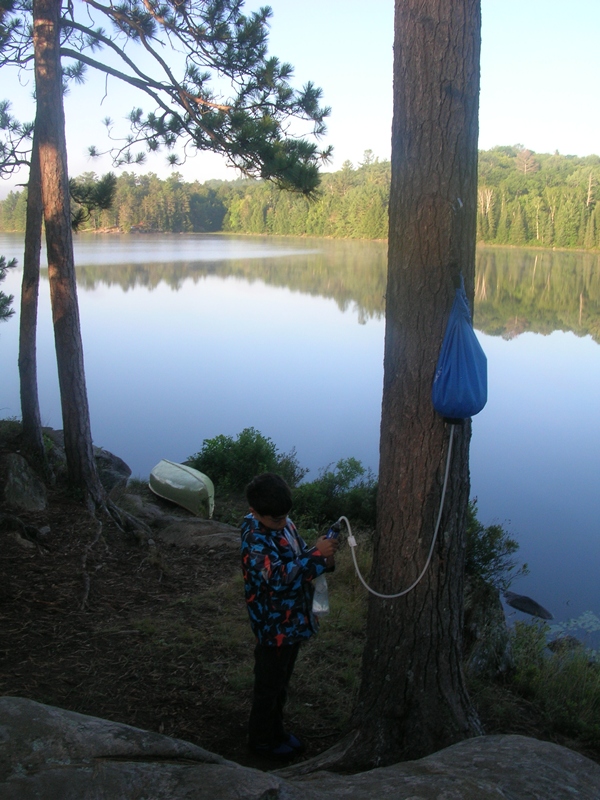
Normally the snapped roll down closures on the bag are wrapped over a tree branch or something, but the weight of the bag has weakened the clips allowing them to spontaneously pop apart creating a watery disaster. A small amount of cordage has been added to serve as a support loop. This way, the bag can be hauled up a tree for extra gravity power. Here's a pic of it slung up a tree branch on the property.

 Suspended filter bag


The original white shutoff clip still works to clamp down on the hose, but this edition of the Sawyer filter also has one of those pull up bottle lids to also stop water flow. When opened, the filter immediately begins to go to work with a decent flow.

Water filter working

The white clamp clip can also be repositioned anywhere on the hose. When moved to the very top and clamped it allows for draining of the hose.


The other nice thing about this mod, is that without the original, delicate pleated membrane encased in the bag, the whole setup can collapse into a tighter package. Here it is all bundled up and ready for packing.

 Bundled up

On our 3 day trip to the Frost Centre earlier in the summer, the system worked flawlessly. We set it up high on tree and used the filtered water constantly to stay hydrated. Here's a shot of the little guy using the filter to fill up our collapsible water bottles.


Many thanks to the original poster on the BWCA forums for sharing his method. We'll be using this setup for years to come!



Saturday, October 22, 2016

Historic Paddle Photo: Geological Survey of Canada

Here's another historic photo from the Archives of Canada.  Taken at an unknown location as part of an 1895 Geological Survey of Dr. R. Bell, the photo features men loading supplies into their bark canoes. 

Aboriginal men loading supplies into birch bark canoes
Photograph taken at an unknown location.
Credit: Geological Survey of Canada / Library and Archives Canada / PA-045620
Restrictions on use: Nil
Copyright: Expired


While the location was not recorded, the sharp stem profiles of the canoes look much like what Tappan Adney classified as the "Algonkin" type.

Old Model, Ottawa River, Algonkin Canoe


A few paddles are also visible in the scene. Here is a zoomed in version of one of the men with his straight sided paddle ready for action...

paddle closeup


Thursday, October 20, 2016

Halifax Maritime Museum of the Atlantic: Another shot of Mi'kmaq canoe & paddle

The Maritime Museum of the Atlantic in Halifax features an old Mi'kmaq birchbark canoe on display behind a glass case. Included is a paddle which has warped over time. A previous post from 2013 features some photos taken by Lloyd of Canoe Canada East.

Found a blog of another museum visitor who captured another angle on the paddle. It shows the extreme tapering of the grip area from the side...

Photo Credit: Marelene Hutchins 


Newer Posts Older Posts Home Page